Alcohol Inks: Fun, Easy, Mindful Art for Busy Moms


 Apple Podcasts
 iHeartRadio
 Spotify
 Amazon Music
 Castro
 RSS Feed
 TuneIn
 Podchaser
 Goodpods
 Castbox
 Do you get frustrated because your creative endeavors are constantly interrupted? Do you hesitate to start projects because you know you won't have time to finish them? Do you miss having a creative outlet? This week on the #8 stress podcast, I chat with Faigie Kobre who is an expert with alcohol inks. Alcohol inks are a fun and simple way to find creative expression especially if you feel like you "aren't very good at art." The beauty and simplicity of alcohol inks make them a great mindful art project for anyone! Listen for more on how to use them and why you might fall in love with this form of creation.
#mindfulart #mindfulness #mindfulnesscoachforkids #mindfulcreation #mindfulactivities #thestressnannypodcast #thestressnanny #creativityreignited
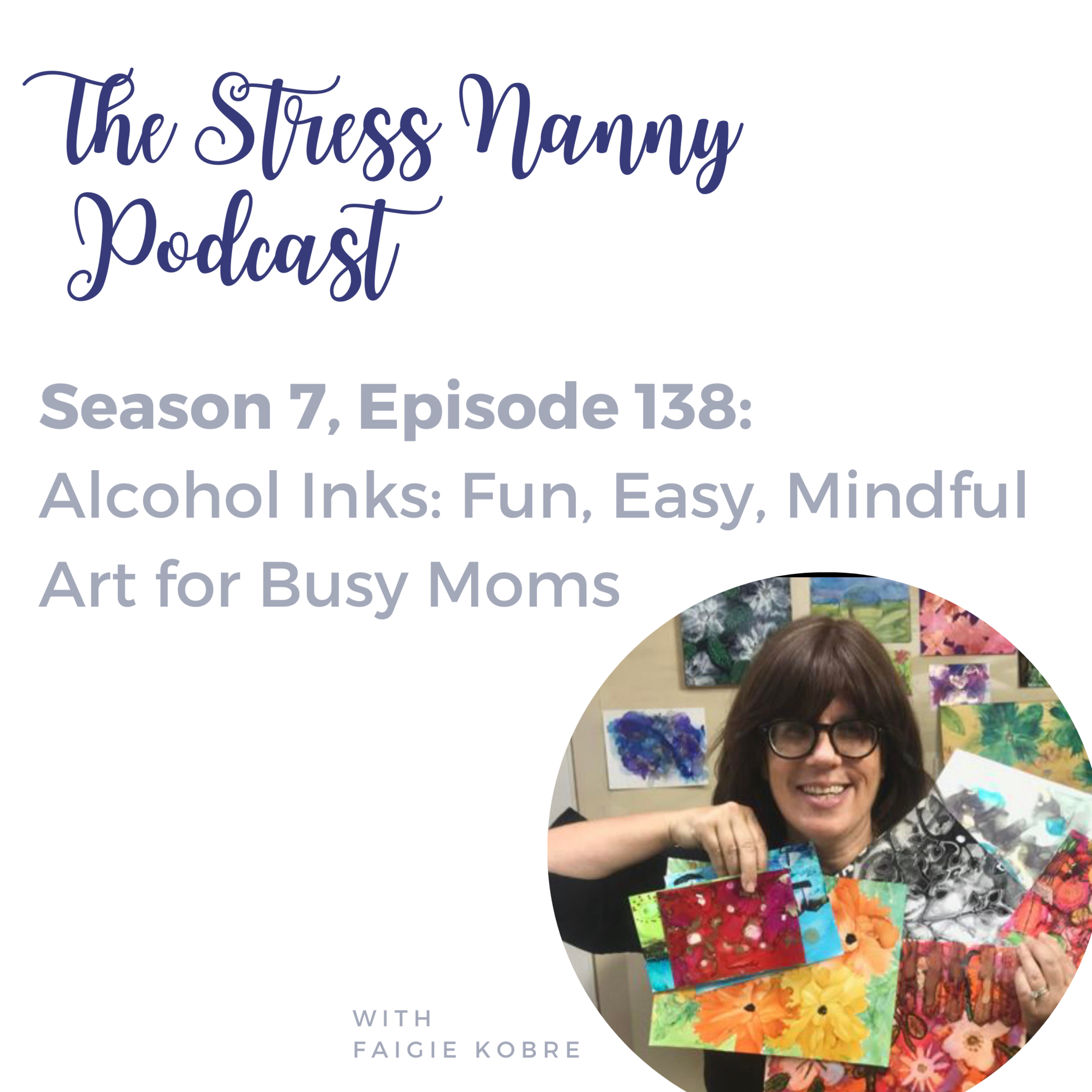
Faigie Kobre is an elementary school art teacher & also works with adults who are looking for a creative & relaxing outlet. She uses the medium of alcohol inks which is a vibrant, flowing, forgiving & relaxing medium. There are so many benefits to having a creative outlet & lessening of stress is one of them. Find more about Faigie on her website, Instagram, Twitter or Facebook.
Lindsay Miller is a kids mindfulness coach, mindfulness trainer and host of The Stress Nanny Podcast. She is known for her suitcase tricks and playful laugh. When she's not playing catch with her daughter or rollerblading on local trails with her husband, you can find her using her 20+ years of child development study and mindfulness certification to dream up new ways to get kids excited about deep breathing. Having been featured on numerous podcasts, platforms and publications, Lindsay’s words of wisdom are high impact and leave a lasting impression wherever she goes. To download Lindsay’s Mindfulness At Any Age Guide click 5:92c99b91-42a7-4655-ae85-631f15636dd3" target="_blank">here. To rate the podcast click here.
Lindsay Miller 0:07
You're listening to The Stress Nanny podcast, and I'm your host, Lindsay Miller. I'm here to help you keep an eye on your family stress levels. In our fast paced lives, the ability to manage stress has never been more important for kids or adults. When it comes to stress, we have two choices, we can decrease stress or increase our resilience to it. Here on the number eight ranked stress podcast, I interview experts and share insights to help you do both. When you tune in each week, you'll bring your stress levels down and your resilience up so that stress doesn't get in the way of you living your best life. I'm so glad you're here.
Well, hello there. This is Lindsay, and I'm so glad you're here. Today we're going to explore an artistic medium that is really great for people who don't have a lot of time, don't feel like they're great at art, or feel like they're gonna get distracted or interrupted 14 times if they pull out a project. So if that's you keep right on listening. Faigie Kobre is going to walk us through the use of alcohol inks, which is a medium that I didn't know about. But once I started learning about it, I was seeing alcohol inks and alcohol markers everywhere. So it's really interesting that it's been around for a while, but nothing that I knew about. So she's going to talk us through the process, how she got into it and why it's can be a really great activity for busy stressed out people. In addition to being an artistic outlet, and like giving us a chance to exercise our creativity. I think art projects help us connect with just being human. So I hope you enjoy the episode and pick up a little bit of a desire to get creative.
Welcome to The Stress Nanny podcast. I am so glad you're here for this episode and can't wait to introduce my guest today. Faigie Kobre is an elementary school art teacher and also works with adults who are looking for creative and relaxing outlet. She uses the medium of alcohol inks, which is a vibrant, flowing, forgiving and relaxing medium. There are so many benefits to having a creative outlet and lessening stress is one of them. So her insights today and her invitation to try alcohol inks is what we're here to talk about. Thank you. Thanks so much for joining me.
Faigie Kobre 2:17
My pleasure.
Lindsay Miller 2:19
So when you and I connected, I was really curious because I am such a big fan of exploratory art, especially because it adds so much mindfulness to any, you know, like expression, because there's no way you can kind of go wrong when you're just exploring. So talk to me about how you got into this medium, and why you love it.
Faigie Kobre 2:42
So it's interesting, because when you first said something about exploratory art, it's like it really dates back dates me back to where how I got into all this, this art business if I take a little detour. So I have a my degree as an early childhood education, and I was a preschool, kindergarten teacher, and then I was a director. And then I became one of the things I like best about my teaching, and part of the early childhood was the art. I loved watching, I loved watching the kids become creative. I ended up also becoming a workshop leader, I I started giving workshops to schools, and Headstart programs and all kinds of daycare programs, to the teachers on how to give kids art that's developmentally appropriate. So you just like you just said that. And it reminded me exploratory because the truth of the matter is, a lot of the reason that adults are so inhibited and feel that they can't draw, and they're not artistic is because of what happened with their art when they were kids. Because really, what is supposed to be done with young kids is really exploratory art. When kids are very young. They really should be exploring the materials that said they're learning. You know, when your kid first writes on the wall, you know, picks up a crayon or marker and writes on the wall. They have learned that crayons, markers make marks, not mean we have to teach them that it's only on paper, not on the wall. But what happens is they're learning they're learning what happens it reminds me of a story when I was my my oldest who herself has a bunch of kids now. She was in school for the first time. It was a three year old program and I brought her in for orientation and I was sitting in watching and she sat down and there was a table with some papers and some glue. And she she put she picked up a shape. She put it down on a paper She was finished. And her teacher was wonderful, who really understood kids came and sat down next to her, and she picked up the paper and she turned it around. And she said, look, it sticks. So she understood, this kid was learning, what do materials do? What happens is in so many, so many schools all over the places, the perfectionist tendencies of our society, where we're so product based, and so we only want a product, they don't know to allow kids this exploration, and they don't know how important it is for kids to just to paint and to color and to just make messes because they're learning about the material. And they don't have the skills to know about, you know, form and design. And so what happens is when teachers and parents are very insistent on giving kids like crafts, like very young kids is a very big difference between kids crafts, and adult preps. When they give them these crafts, they are in essence, telling the kids, I don't trust you. I don't trust you to create, I don't trust you to create at your level, I want you to do what we as an adults feel is best. So if a kid is allowed to explore, and then go from stage to stage, they will eventually start doing things representational. I once taught a kid who came from another country, and he had never been in school before I was teaching a five year old program, it was kindergarten. And he came in, he was a very bright kid, and but he went to the easel to paint and he was painting like a three year old. And he painted like a three year old, he just was covering covering covering the paper. And this happened for a few months. And then he started painting, like his painting started taking on form. And in a couple of months, he was painting like a five year old, he started at drawing people, because he needed to go through those stages. And he was allowed to so when kids are allowed to go to those stages, and given what they need, then they're not the adults that grow up and say me, I can't draw, I can't do a straight line because they're, they're allowed, okay, so. So I was doing that I was doing, I was giving workshops, I was doing that kind of stuff. And I ended up leaving to raise a family of a bunch of kids and six to be exact five, five of which are married with their own families. And I became a photographer also, I was a high end portrait photographer for 25 years. So I was doing that I had a studio in my home. I was doing that for a long time. And then at one point, I got very interested in internet marketing. And I started exploring that. And I wanted to do something with it. So they said, just like they say, in writing, write what you know. So I wanted to create an information product. They said, do something that you know, and what did I know, and you are in kids. So I, I started to do that. And I made some ebooks and I started a website for parents and teachers on art that's developmentally appropriate, like to take them away from all this cookie cutter crafts. But then I needed to know how to market this website. So took a marketing course. And in this marketing course, I was talking to the coaches there about my whole ideas and my theories about why adults feel so repressed and inhibited is because of what they got when they were kids. It's not only that, that they got the wrong kinds of crafts, very possibly when they were in elementary school, some teachers said something really negative to them, or parents said something negative about this skills, which just caused them to shut down. So she one of them said to me, did you ever think of starting a website for adults on creativity to teach them where their you know, inhibitions come from and maybe that you then you could bring them back to your children's websites. I said, that's very intriguing. And I started doing research and I started looking, doing research on creativity and adult creativity. I kept coming across this term mixed media, mixed media art. Do you have any experience with that? Mixed Media? Yes. Makes me so I was in LA it was just whoa, this was. And so I started this website, my website creativity reignited. And at first it was mostly about mixed media. And then so I had started this website, and I started some classes. I was doing some online classes, some offline classes. And then one day I was scrolling through the site of my library, looking for books, and I came across this book that said pigments of your imagination, all about alcohol. Lynx and I was riveted. I ordered the book, you know, to my library, I picked it up, I ended up buying it right away. And it was just, it was just it was like, it was just unbelievable, because it is it you know, then of course, I started buying materials, you know, like I think people who are into crafts and art, they know that they that the reason they get into different different idea, you know, different hobbies of different crafts is really just an excuse to buy more art supplies. Anybody, anybody who's in Tibet knows that that in itself is just a hobby on its own, you know, just buying craft supplies. And so in the I get a rush, anybody anyone's listening? Yeah, who's done that? They certainly don't know what that's all about.
Lindsay Miller 10:45
And then you get to organize them and like, get everything set up together. Yeah. Right.
Faigie Kobre 10:51
So then I really got into the alcohol links. And I just, I started seeing when I was I would give classes and I would just notice how people were mesmerized by them. And there was just like a certain flow, it's like they're very uncontrollable, there are different ways to control them also. But for the most part, like out of the box out of the bottle, they're really pretty uncontrollable. And I had a woman who was a client of mine, and she told me, she I think she had taken some of my online classes, she said she went through a real difficult medical cycle with one of her kids. And that this alcoholics was a lifesaver. First, you just go and work with it, and it would take her out of her, you know, you know, present everyday troubles. I also spoke to a woman once on online who was telling me how she had had a lot of loss in her life, she had lost just, you know, grandchild and a child and she was telling me how she used to she was into alcoholics and how she was when she would work at a whole night. It was just And She only did like there's one specific technique she was working on. And there is just something about the medium that is very calming and very relaxing and allows you to get into the flow. And it's also it helps you if you're a perfectionist that helps you get rid of your perfectionism because it's you can't really control it very well. Like I said, there are different ways to control there's all different kinds of techniques but so that's that's a that's where I am I you know, like I like to start people off the truth is when people are people want to get into alcoholics. So like I I created a video which is actually on my my site that creativity reignited it's a 20 minute video showing you how you can get into it using alcoholic markers, which are Sharpies, okay, I didn't even learn that until I was well into my alcoholic journey. So if you want to try something to begin with, you could just take some sharpies and some alcohol and I have like, six activities to just kind of get you into it. And then you know, there's a way to get people into it. It's not even something like your I know there are there are a bunch of women that are really, really artistic. And they use they who they know how to use. They know how to use them, the alcohol links to real really paint and make gorgeous gorgeous things with it. But there's another whole, you know, group of people that I'm not capable of that, like my market is for people who can draw and want to still be able to be artistic. So but I have another student who was with it with me with my mixed media and then she came along with me with the alcohol wings. She moved out of the country and she told me recently that she's taking oil painting classes now. Now she this was someone who so didn't think of herself as artistic. And now it's kind of it's just unlocked it. So I don't even necessarily think of alcoholics as a, you know, you'll learn to paint like Rembrandt or you know, at a yo yo become Grandma Moses at whatever age. But it's a look at it as a great way for stress relief for mindfulness. Because you really just allow yourself to focus and to have a good time, you can make beautiful things also. So it's just it's just something that I feel is a is a great medium for people to get into if they just want to reignite their
Lindsay Miller 14:21
creativity. Yeah, no, that's thank you for sharing that. I think that the curiosity factor is fantastic because it's kind of like you're describing in the ones that I've looked at and like as I've you know, studied your work. It's, it's like you're not sure what it's going to turn out as, right and so you can't go into it with any kind of like you said preconceived ideas about what you're creating, necessarily, if you're just engaging with it in this way. And so, and we know from you know, neuroscience that when we can shift into that creative, curious space, we open up so many parts of the brain that gets shut down if we're free. Feeling a little bit more perfectionistic. And so I love the, the invitation to curiosity that this provides, right? And we can say like, I don't even know, I'm not sure how it's gonna turn out. But let's see what this one looks like, you know,
Faigie Kobre 15:12
it's it's almost like taking us back to our childhoods when we weren't allowed. We weren't allowed to explore, we weren't now we're saying just play, just doesn't matter what it looks like, you know, there are ways to make it beautiful, even if it's even if it's not. Yeah, you know, people are in it for different things. Some people, if people want to really just make beautiful things, there are ways to do that. Just use the right colors, you know, and there are people who just really want to play. So you know, there's room for everybody, you know, like they say, tech sales something for everyone.
Lindsay Miller 15:47
Yeah, well, and one of the things that I was really drawn to you know, about your work and about this medium was the, the fact that you could do it in tandem, right? Like sometimes for adults, it's challenging to sit down with with your kiddos around and work on a project because like, we were saying, if you have an end result in mind, you're trying to, like if I'm trying to embroider something, or if I'm trying to paint something, or if I'm trying to, like calligraphy have an end result that looks a certain way. Sometimes it can be frustrating when we get interrupted or if someone comes in bumps our arm or if you know, there's just during those years when kiddos are afoot, it can be challenging to find a creative outlet that's conducive to interruption. Right, but this one is is like perfect for that.
Faigie Kobre 16:34
Yeah, yeah. I mean, the truth of the matter is, it's I have done I have done it with my, with my grandchildren also, I do you know, it's funny, there's a lot of, there's a lot of talk online about the safety of it. So it's, um, it's used with alcohol the same way. The same way water is for water colors than alcohol is to alcohol. And that's how it you know, that's how it gets it to move. That's how it gets cleaned up. And there are people that are more sensitive, there are people that are more sensitive, I recently did a quiz with a bunch of ladies here. And one lady actually said it was bothering her and she had to leave. So there are people who are very, very into alcohol, and they'll wear a respirator because they love it and they do it all the time, I only find that I have a problem if I use a lot of alcohol, if I just use the inks. So there are people that say don't do it with kids. So depends how much you're doing it, I don't you know, I don't think it's such a big deal. If you you're you know, you do it a little bit and, and the kids really love it, my grandchildren just, they just love it the it's just because it's just there's something magic about it, you have to work on non porous surfaces, and you just like they like little bottles and you like spread it and it just spreads and then you put another color on top of it and it spreads, you don't know how it's going to act and then you add some alcohol. So it is very cool. It is something that people can do if it's not, you know, if it's not like you're right on top of it, and you just inhaling it, even though it's funny because they you know, the people that are always talking about you must use respirators, like nurses are using alcohol all the time in the hospitals, I mean, during COVID, you could not get alcohol, it was it was just nowhere to be found. You know, you know, but so what I'm saying it is something that you can do with your kids a little bit just
Lindsay Miller 18:31
well, and you want to be mindful with you know, as with any activity where you're where you're using materials that are, you know, maybe aren't native to like children's crafts, like, you know, finger paint or things that are non toxic, you want to be cautious and aware, but it's
Faigie Kobre 18:47
not so once in a while, right, I'm saying but once in a while it's not, you know, something that you do when you take all the safety precautions, it's really, you know, I haven't been really affected by it. And a lot of people I said, you know, there's all kinds of arguments online, you know, you know, I My lungs are bothering me and although I've been using this for years, it's not a problem, I guess it's you know, people have different sensitivities. So it's a, you know, so really depends on, you know, on your situation. Yeah, you know, the truth.
Lindsay Miller 19:16
Talk to me about you explain the process a little bit talk to us about the process of it and what it entails and how, how to kind of get started with it.
Faigie Kobre 19:26
Okay, so you need, you know, I always knew that if I use Sharpies, if you have like regular washable markers, and you try to put it on plastic, it doesn't really write but sharpies you can always write on anything. So that's because alcohol inks works on non porous surfaces. Okay, and it takes to it and plastic isn't a non porous surface. So you have to work on a non porous surface even even if you're if you're starting with markers was like, in my videos, you'll see you could use tiles. This is a specialty paper that I use the backside of certain photo papers are very good, not all of them. But you know, I talked about that, like I said tiles, you can use aluminum foil. So you could start with markers. But if you want to get more, then you just buy they have them in all the stores and Michaels and Hobby Lobby to get them online actually don't get them on Amazon because I find that they even though I gotta I get a lot of stuff on Amazon, I find that they're more expensive. They like Jo Ann's fabric stores I find has them for very cheap. So basically you have that data and you need like 9090, at least 91% alcohol because the lower alcohol is watered down. And you you take a piece of this non porous surface, a tile and you you just drip, and then you watch it. And then you drip another color. And then you add some alcohol. Now this is all the beginning, this is all the beginning stuff, because there's so many so many things to do. And I do people want to come on a journey with me, I definitely take them. And there's lots of different ways to use it. Then you can start blowing, you can blow this blowing implements, there's a woman that does these beautiful whispies on YouTube, she uses a blow dryer, you know a low wattage blow dryer, then you can use stencils, you can make a beautiful background, and then you can take a stencil and wipe through this like really a lot, a lot of ways. You do have to go online, there's lots of videos online. Also, if you want to see, you could start with my like my marker video. And you know, I actually have I have on my YouTube channel, I have YouTube, my Instagram also I've had I haven't been so active on social media lately, but I have a lot of stuff that is on there that you know if they want to go see some more. So
that's one good way to start.
Lindsay Miller 22:04
Yeah, thank you. Well, and it was interesting, because after, after you and I connected the first time I started noticing like alcoholic markers, alcohol, you know, like I started noticing in a lot of places and has always been there. I just hadn't see, you know, I hadn't had eyes for it before, before you had reached out. So let's revisit this idea of process art. Because I do agree that like with kids, it's so important to help them just experience the process of creation, right experience, experience the different materials, like you said, and learn what they do and how they work and just be able to be immersed in the process of creating something that wasn't there before as opposed to trying to create a certain outcome. Now, for adults, like we've talked about, there's some challenges if that hasn't been our experience. And you mentioned like perfectionism and art being stressful, right? And so if people who are just having an aversion or feeling like just stressed out even thinking about creating something, what's your encouragement in those moments to kind of just explore this medium, what you've said is so friendly for people who maybe have that tendency.
Faigie Kobre 23:17
First of all, I would try to
tap into where it comes from. Think back to yourself sitting in your classroom with a teacher who is very perfectionistic and very critical. And you know that yours is not going to be as good as your friend sitting you know, in the next aisle over. And you need it to be looking a certain way. And just try to remember where this came from. Did one of your parents say something to you, oh, you'll never be an artist or you were very proud of a drawing you made and somebody laughed at you or said something if you can tap back into that and you'll realize how that's what started it and let's what try to wipe the slate clean and let's let's look I tell people you couldn't you can't go wrong with alcohol links if you just use the right colors. So sometimes people will start throwing things on login I have in in one of my one of my videos I probably have a like a teaching you with the color wheel and how to make sure that the colors work with each other. And then it's just a beautiful abstract and then you you add some gold. So just realize you have to realize that there is realistic art. Okay, go back, people don't expect everyone to be able to sit down at a piano and play Beethoven right without taking lessons now. You do have some people that can do have people that are born with perfect pitch you people that can sit down there musically, the musical geniuses, right? But that doesn't stop other people from taking lessons because they want to learn how to play the piano. But for some reason, in art, people think that if you're not born with a pencil in your mouth, and that you can just draw beautifully, then you just are, it's not for you. And that is very sad. That is very sad. Because art has such healing properties. It is so healthy, and it's so good for your mental health. And there's so many different ways to do it. And it doesn't matter if you're not selling, it doesn't matter if you're not winning any any shows or you're in a gallery, it is just for the process itself. And it's such a pity that so much of this has been taken away from us, because it's been given I look, I want to take it away from the artists, artists as artists, not just for artists, it's for everyone who likes it.
Not everybody not
my mom was here recently. And she's like, she's like, 84. And I was talking about what I didn't she said to me,
you know, like, Well, why would people be interested in that? Because she has zero interest in
art, you know, like, Thanks, Mom. You know?
She, I never discuss it
with her because it's not her thing. But it is. And it's not for everyone, if you're the type of person like I used to walk around in art supply stores and salivate. I wish I knew how to use this. And if somebody can understand that, it's like, it's like, we will find each other, you know, people, yeah, just that that feeling I want to use it. I don't know how I'm not good. I can't draw, I can't even draw a straight line with a ruler, you know, all these things that's so common. And I say, let's take it back, or you do not know have to know how to draw realistically, if you want to know how to learn how to draw realistically, you can, you can, it's hard work though. The same way you have to sit and practice your piano to get where you want. So if you want to learn how to draw anybody can there's a very well known program drawing on the right side of the brain, Betty Edwards. I don't know if you've heard of her. But it's just hard work. And if you just want to have fun, it's like I coined I didn't coined this term, I got it from someone else. But she said, I do fun art, not fine art. Dena Wakeley, I get accused of big mixed media artists. And that's a thing you know, and I use that all the time. It's fun art, not fine art. And art is for everyone.
Lindsay Miller 27:29
I love that so much. Yes to all of those things. And I love the experience you described of walking through the aisles at an art store or a craft store and feeling drawn to it, but simultaneously feeling like repulsed by it because you don't know how to use it or you won't be good at it, or it's not gonna work for you, or you've never been, you know, and I can really appreciate that moment. And so I hope for people who are listening and feeling that poll to what you're saying, like to engage, like maybe this is a way for a way in that like, maybe this is your bridge into fine art, you know, maybe alcoholics is your bridge in. And after that you can get a little bit more exploratory and a little bit more open to other media that you might enjoy, or to other opportunities to just develop that part of us. That is innately creative,
Faigie Kobre 28:22
right? Yeah. Yeah. Because we were all born we were all born with
creativity. It's really, it's really, it's really, it's a God given gift to everybody, for everybody. And I think it's a shame if people don't use it. Now, not everybody. Some people can be creative in a lot of different ways. Like we said, music, there's this cooking, there's there are a lot of ways to be creative. But some people for some reason think art is is more and and I love art. So I just think for anybody that has any kind of any kind of desire to it. It's just a shame not to use it.
Lindsay Miller 28:56
Yeah, yeah. Well, and I think to being able to engage with it in this way, like you said, lowering your inhibitions around it lowering like there's the pretty low barrier to entry, right? The materials aren't going to break the bank, you're able to explore on, you know, pulling out some aluminum foil from your kitchen drawer, right? There's just different opportunities to engage with it that aren't, yeah, it's not going to cost you a ton to get started with it or to practice it, but it might have the potential to bring you pretty massive amounts of joy once you open yourself up to that part of you. Right, right. Right. That's right. What are some of the other benefits that I mean, there's so much research about that. Right? What are some of the other benefits of creativity for people?
Faigie Kobre 29:43
You know, I read a book
written by my husband and wife team, both doctors called the creativity cure. And they they were talking about that it has been shown that people that are in volved in creativity have no like, it works better than therapy. You know, they were talking about the importance of handwork. So there's handwork and creativity, you can do hand work. That's not necessarily so creative. I mean, gardening can be creative, but it's like handwork. And the, the, there's been so much research and data, talking about what it does for you, it, how it calms you how it, it just is a sub, this some kind of healing. It just, it takes your mind off of your problems, as one woman had told me she, you know, it's like she finds it a vacation without, you know, going anywhere. It's you kind of going into a space that, that, you know, they also talk about the flow state getting into flow state, but I
Lindsay Miller 30:49
think, you know, yeah,
Faigie Kobre 30:50
it's just, it's just this so much healing that, you know, that comes from it, just anxiety, anxiety, ruminating. Because so many, so many, you know, the stress of everyday life, it's just like, it centers you, it calms you, it takes you away from your phone. That's a big one.
Lindsay Miller 31:16
That was something, something that's so engaging, and really does like, invite and entice you to be fully present, right. And that's where like, when we're navigating distraction, or we're feeling like we have racing thoughts, something that will allow us to just kind of center and ground into that moment, is such a gift, right. So in addition to the benefits, you know, the more universal benefits of creativity when it comes to mental health, even just the the opportunity and invitation to get present. And to practice being present, is so massive and insulating for for any age.
Faigie Kobre 31:55
I have a small group of women, like for the past four or five years that we meet sporadically. We have like a little this is mixed media we've been doing in my basement, and one woman tells me I tell my husband all the time, it's cheaper than therapy, you know, it's Yeah, but she says I come home after a full day of work. She says it's just, it's just so beneficial for me, I just, you know, just to unwind and to, you know, so?
Lindsay Miller 32:21
Yeah, well, and I think you pointed this out earlier, there is a tendency when we're exploring things that feel a little edgy to us. So like you said, if you feel a little nervous about trying alcoholics, or any kind of art, and you engage with it, and you kind of let yourself be drawn in, there are things that we learned about ourselves, there's an awareness that comes about why we did not do this before, right? What got in the way,
Faigie Kobre 32:48
that's so interesting that you say that also, because I find that people's personalities come out in there are also very, very fascinating. Yeah.
Lindsay Miller 32:58
And so I think, I think in addition to the process of creation being soothing, that the opportunity to engage with some of our habits or patterns, or the things that block us from doing what we want, that that's an opportunity, we take in these moments, too, right? Because so many of us are inhibited by art. And if we can kind of lean into that in if we can kind of lean into that tendency to shy away from it. And let ourselves get brave or get courageous and lean in and do you know, try it and experience the benefits of it that can also kind of domino into other aspects of our life, right? Where we try something. Oh, and
Faigie Kobre 33:38
just to say yes, yes, for sure. I see that in my elementary school class. Also, I've spoken to teachers, like the kids that are alive, who are having maybe difficult to things I see how it just could seep into other areas of our lives, for sure.
Lindsay Miller 33:53
Yeah, and especially I feel that way, especially with kids too, as we were if we can tackle some of our tendencies around art and perfectionism, then we invite kids even more graciously into that space of creation and exploration, then like their, their limitless, right in terms of the things they can explore as a result of like, just engaging without fear of doing it. Right,
Faigie Kobre 34:18
right. Yeah, sure.
Lindsay Miller 34:20
No, I love all of that. Yeah. Well, just one more thing. If people don't have a lot of space, this is also a really great medium for them.
Faigie Kobre 34:31
Yes, well write your kitchen table you get a nice box and you put it in a box and then you just you know sit down when you have some time and you know open up the box and put it away. You don't need a whole studio. Of course the whole studio is nice, but you don't need a host really don't you need a table and a box for it to store your things. That's
Lindsay Miller 34:50
just a couple minutes right. I mean, you could sit down cat
Faigie Kobre 34:53
you can Yeah, you can do
it. Yeah, you can do it for a few minutes. You can go on it dries also very quickly. It like in 10 seconds. stuff is dry unless you throw a lot on it. And then you could continue it later because you can always reactivate it. It's not like it dries and you can't use it. All you do is add a little alcohol more ink to it. And it's reactivating. So it's you could do it for a few minutes at a time and then come back to it to shore.
Lindsay Miller 35:15
Yeah. And that's where I love. Yeah, I love when you and I first connected around this, like, it does seem like such a great activity for people who are caring for others, especially small people who tend to interrupt creative endeavors. Because it's like you said, if you can just get it out, it's in, it's in a box, you keep your box up on the shelf, you can pull it out, when you have a minute, if you get interrupted, you can put it away. And it's not like you have to dry it somewhere else. And then also, if somebody bumps you while you're doing it, or wants to play with you, or try it for 10 seconds while they have some, you know, while they're interested in it before they run off and do something else like it's so conducive to just inactive kind of busy mom lifestyle. Yes, for sure. And any lifestyle. Yeah.
Faigie Kobre 36:01
What, except if you have asthma, you know,
Lindsay Miller 36:07
asthma? No. Thank you so much. Thank you for joining me today. This has been such a great conversation and talk to me about where people can find more about you and your work.
Faigie Kobre 36:16
So like I said, on my website, creativity reignited, that's where you would go and sign up and get that free video. And then I'll take you along on a little journey. And then I do have, you'll probably put in the shownotes. I do have an Instagram account and a Facebook account. I'm going to be starting to post more than that it has a lot of material there, though. I did that for a very long time and then just busy with other stuff. So but there's a lot of stuff. If you want to get a really good idea of what it's about. You can you know, you could check out any of those three things.
Lindsay Miller 36:49
Yeah. Well, thank you again, this has been such a fun conversation.
Faigie Kobre 36:53
Okay, thank you so much for having me. I hope everybody gets really creative.
Lindsay Miller 36:57
Me too. Well, what did you think? Did it make you want to try alcohol inks? I know this conversation really just did reignite my creativity and make me feel like it's worth taking the time, right? Sometimes it can be so tricky in the thick of a busy day to make the time for creativity. But even just the simplest things like this morning, I decided to make Jessica's note, I always put a note in her lunchbox still a little bit more artistic. So I was putting like dots on her name, you know, as I was decorating it, and I put a couple of stickers on it. But I think even just taking the time to do super simple things like that, you know, it took me less than a minute, but it was something creative. And I love the idea of bringing creativity in to our lives in a way that makes it fun and enjoyable and rejuvenating. So I hope this conversation invited you to let go of some of your resistance around it. And to get curious about alcoholics. I would love to hear if you give them a try. And I'd love to see pictures of what you create. Thanks again for being here.
You've just finished an episode of The Stress Nanny podcast. So hopefully you feel a little more empowered when it comes to dealing with stress. Feel free to take a deep breath and let it out slowly as you go back to your day. I'm so glad you're here. If you're a longtime listener, thank you so much for your support. It really means the world to me. If you're new, I'd love to have you follow the podcast and join me each week. And no matter how long you've been listening, please share this episode with someone who was stressed out. If you enjoyed the show, would you please do me a favor and go to ratethispodcast.com/thestressnanny and leave a review. The link is in the show notes. I'm so grateful for all my listeners. Thank you again for being here. Until next time!
Transcribed by https://otter.ai