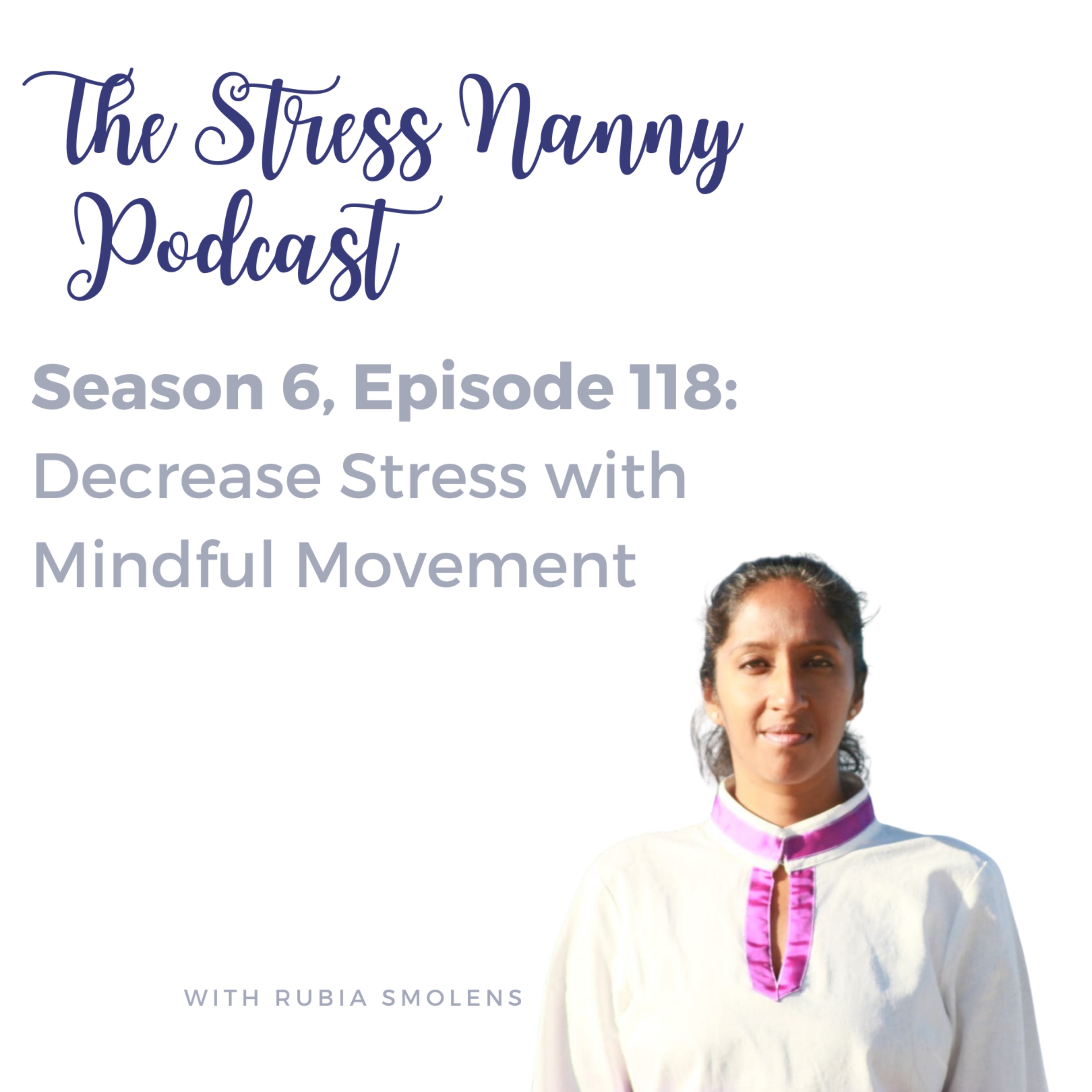
Decrease Stress with Mindful Movement


 Apple Podcasts
 iHeartRadio
 Spotify
 Amazon Music
 Castro
 RSS Feed
 TuneIn
 Podchaser
 Goodpods
 Castbox
 On this episode Sifu Rubia Smolens walks us through the benefits of Tai Chi and shares some simple ways to phrase this mindful movement practice for kids and adults. Learning to slow down can be challenging in our fast-paced world but adopting a practice like Tai Chi or Qi Gong can make it easier to create a mindful-movement habit which can help us access calm anytime. For many years, Rubia has introduced people to tai chi. Her practices are easy to relate to and learn. Give them a try! She is offering a free Qi Gong course to listeners. Go to taichiwellness.online and use code nannyqi for 100% off your purchase. You can also find Rubia on Instagram @weiwutaichi
Sifu Rubia of Wei Wu Tai Chi discovered the benefits of Tai Chi and Qi Gong as a way to heal herself. It is her mission to share these ancient healing practices with others, giving them the tools to maintain health, rejuvenate their bodies and recapture youthful energy and equanimity in their lives. Rubia's training includes Classical Yang Family Style Tai Chi, Yoga Naga (a warrior form of Yoga) and Iron Shirt Qi Gong. She has taught in community centers, drug and alcohol rehabilitation centers, private group classes, along with speaking engagements at corporate functions such as the Oprah Winfrey Network Offices in Los Angeles. She recently created the online courses Tai Chi Fundamentals for Beginners and Qi Gong - For Grounding learn more at taichiwellness.online
Intro Tai Chi Course:https://courses.weiwutaichi.online/courses/Tai-Chi-Fundamentals-for-Beginners?ref=934f79
Intro Full Qi Gong Course:https://courses.weiwutaichi.online/courses/qi-gong-for-grounding?ref=934f79
These two are available on a sliding scale:
To Pay:
$59 use VIP CODE: SCQ59
$79 use VIP CODE: SCQ79
$99 use VIP CODE: SCQ99
The Short Qi Gong Course: https://courses.weiwutaichi.online/courses/short-qi-gong-sequence-for-grounding?ref=934f79
For Free Access use VIP CODE: NannyQi
(60 day access to this course)
Lindsay Miller is known for her suitcase tricks and playful laugh. When she's not playing catch with her daughter or rollerblading on local trails with her husband, you can find her using her 20+ years of child development study and mindfulness certification to dream up new ways to get kids excited about deep breathing. Having been featured on numerous podcasts, platforms and publications, Lindsay’s words of wisdom are high impact and leave a lasting impression wherever she goes. To download Lindsay’s Mindfulness At Any Age Guide click 5:92c99b91-42a7-4655-ae85-631f15636dd3" rel="noopener noreferrer" target="_blank">here. Please follow this podcast, share it with a friend and give rate the podcast here!
Welcome to The Stress Nanny podcast. I'm your host, Lindsay Miller, and I'm so glad that you're here to make your life a little less stressful today. This week's episode is brought to you by the essential calendar which is a beautiful 18 by 24 wall calendar with fun accessories that make it easy for families to get organized. The summer break calendar will take you from Labor Day to Memorial Day so you can see the whole summer at a glance. You can find it exclusively at www.centralcalendar.com. I am so excited today to introduce my guest Rubis Smolens. She has discovered the benefits of Tai Chi and Chi Gong as a way to heal herself and it's her mission to share these ancient healing practices with others giving them the tools to maintain health, rejuvenate their bodies and recapture youthful energy and equanimity in their lives. Her training includes classical Yang family Style Tai Chi, Yoga, Naga, and Iron Shirt Chi Gong. She's taught in community centers, drug and alcohol rehab centers, private group classes, along with speaking engagements at corporate functions such as Oprah Winfrey Network offices in LA. She recently created the online courses, Tai Chi fundamentals for beginners, and qi gong for grounding. And we're going to talk about that today. Among other things, Rubio, thank you so much for being here. I'm so excited about this chat.
Sifu Rubia Smolens 2:46
I am excited to be here to Lindsay. Thank you for him having me. It's it's an honor to be here. And I'm looking forward to it. I really am. Yeah.
Lindsay Miller 2:55
So help us get to know you a little bit better. How did you come to feel so strongly about Tai Chi Chi Gong, we've talked about how you also have practiced yoga, which I have more familiarity with, help us understand how these came to take such a prominent place in your world.
Sifu Rubia Smolens 3:13
Well, through injury and just, I've always loved movement, and then all of a sudden, I couldn't move anymore. So that was really difficult for me. And he came that the injury came through, you know, the loss of of pregnancy, so I miscarried. And it just it really affected my spirit, my body, all of the all of it. So and on top of that my regular yoga practice was aggravating my back. So I, you know, I've discovered Qigong it was, it was a different way to move and strengthen my body and in it was just a different way. So I discovered it after that injury, and I did Qigong pretty intensively for three months. And then I discovered then I incorporated Tai Chi, I had discovered Tai Chi before, but we were talking off Off mic before and I was sharing that. I walked out of my first Tai Chi. It challenged Tai Chi challenges you and a lot of ways and if you're not ready for it, then yeah, it stirs things up. So I wasn't ready for it. And it took me years before I took another class. And even the second time, I didn't walk out of class, but I still didn't feel a connection. It was the third time after the three months of Qigong, I had cultivated all of this really beautiful strength and energy and the Tai Chi allowed me to, to move that energy in In a really beautiful way, so yeah, just based on, I enjoy moving and these practices are just really beautiful ways to move in a gentle way, especially as you age your your body starts changing and and the joints are, you know, they don't they just don't move the same way. So. So long term health, I've just I've noticed a lot of benefits through these practices, particularly Tai Chi. Yeah, yeah.
Lindsay Miller 5:33
When I appreciate you sharing your story and how you came to it, I, my heart is hurting for you. And in my mind, I'm also feeling like a deep connection, because I think that my own experience with miscarriage is what brought me to yoga. And so I can really appreciate that desire to keep moving. You know, and like when movement is curtailed, for some reason or another, to have other practices available that support that desire to move. And, and I think that yoga is maybe a little bit more generally known, then then Tai Chi, I would, you can totally disagree with me there. But I think
Sifu Rubia Smolens 6:14
it absolutely is. But it also is very intimidating, especially how it's depicted. It, there's only one limb of the eight limbs that are, you know, really prevalent in, in the West, and it's the asana practice, so that's fine, there's more to yoga or the system of yoga, then then an asana practice, but it's definitely a big part of it. And then it's gotten a little contorted to, you know, to us, maybe a little bit of a pun, that, you know, people are contorting themselves into these, these yogic asanas. And it's not really what it's about. So therefore, it can be a little bit intimidating, especially when it's, it's, it's in your face that way all the time. Whereas Tai Chi, not as not as well known, but just as ancient technology and practice, in like the 1000s of years that it's been developed. But it's a little less intimidating and easier, let's say you haven't moved in a long time, for whatever reason, either due to injury or life, you know, just life happens. It's a really nice way to get back into movement. And then, you know, yoga can flow in in there as well. I've been blessed that I've been able to incorporate all three that chi gong, Tai Chi and, and yoga, and it definitely makes for a well rounded practice spiritually and physically. And there are little like nuggets there that I get to experience because of all knowing that it's because I've incorporated all three, if that makes sense.
Lindsay Miller 8:02
Yeah, yeah, no, it totally makes sense. So on as you and I were talking earlier, just the, the mindful movement of Tai Chi is so beautiful to me. And it's so contrary to the way I usually move in the world. I'm a little bit of like a bull in a china shop, sometimes where I'm like, crashing into stuff and hurrying you know, rushing around and banging my hip on the counter. And all the different ways that I move in the world are very contrary to how I move when I practice Tai Chi. And so the the mindful movement piece, I think can be so accessible, like you said in times of injury or limited mobility. And also just to slow down, right, like a lot of times we don't think of exercise or activity, as like slowing down. But moving in that mindful way. It just does something different, right? Like you get a totally different experience in your body. That's so powerful and beautiful.
Sifu Rubia Smolens 8:59
i And when you first start, and I remember as a beginner and what I love about teaching beginners is that you're always in that space of curiosity. So I've always, through my teaching, practice, been able to like keep my beginner practice my own experience as a beginner. So that's kind of been a gift as a teacher. And I remember the progression of wanting to move through through things quickly. And being like really mindful or reminded to slow down and then developing. Excuse me, and then developing a slower, more mindful, practice, like really, really slow. And now through that work, I can only move slowly and it's just it's such a beautiful place to be in and yeah, the gift of time, right time gives you You those those, those beautiful moments? Yeah. Yeah, for sure.
Lindsay Miller 10:06
Well, and let's get into the practice a little bit like specifically what it entails. And you were kind enough to offer me a glimpse of one of the classes on your website, which I've loved like you, I got access to one of her abuse classes. And one of the things that I noticed immediately was how comfortable I felt learning Tai Chi from you. Like, I've learned it in other settings, or, you know, like, in other places, I've had exposure to it. But it always felt I didn't feel the same kind of connection, as I felt like, you know, in the background of her teaching, there's this gorgeous view of the coast and you can just see the water and the land. And she's there with like, her soothing voice and the music and the examples were very clear, like the highlight of your foot when it was like the, the walking drills and being able to just really get clear on how to move. Because even though it's pretty simple, right? It there's like some real technicality to it. And so I was totally comfortable learning from you and these gorgeous videos. So I just want to say as we get started, like, this isn't just any Tai Chi experience that she's describing, or are offering in this space. This is like a, it's it was so unique and so beautiful. And it had I mean, there's such a high impact here. So as we're, as we're considering it, like with an open mind, and with curiosity, like my invitation to you is to just engage with this conversation in that same way, like, how might this serve you?
Sifu Rubia Smolens 11:38
I'm so humbled by that was that was really beautiful. I, again, I'm humbled. And I'm glad that you were you were ready at that moment to receive it in a different way. I mean, that's, that's beautiful. Thank you for sharing that. And honestly, it's, it's the 10 years of experience of teaching that's come through, like just studying people and studying how they, they process the work and really breaking things down in its simplest form as much as possible and giving small segments anyways. Yeah, we could go back to
Lindsay Miller 12:18
you. Yeah, so no, and you really did that, like made it very clear. So I didn't feel awkward. I think one of the things I felt before when I've tried to learn Tai Chi is like I'm watching other people move so gracefully and beautifully. And I'm like not. And I'm also like, Wait, what did you do with your foot? Right there? How did that go? But I didn't feel awkward like you made it so that I didn't feel Yeah, I mean, maybe that's, there's so much of me coming through with that like awkwardness, learning something new. I mean, why should I? Why should I know if I haven't learned it. So there's, I want to, I want to say that not everyone might feel awkward, that might just be something that I feel approaching Tai Chi, but this time I did it. And so talk to us again, as we just dive into the Tai Chi itself, what it is and how it's different. So if someone has never practiced, hardly even heard of it, what is Tai Chi.
Sifu Rubia Smolens 13:08
So I can speak to both Tai Chi and Qigong a little bit to differentiate them and then bridge them. So Chi Gong simply means to work on your vital energy, your vital force, and if you're familiar with yoga, then that's prana prana energy. So, our vitality and then Chi Gong there, there are different systems, different techniques, it can get very heady and medical and technical. Although for me, it developed my spiritual practice and my energetic practice. And then you benefit from just from the practice you benefit from the the medicinal properties. So it is very separate from Tai Chi and, and its own systems. And then Tai Chi is, is the martial expression, I guess you can say, of Chi Gong, so it is a martial art. It's one of the highest disciplines in martial arts to to take on. It's an internal art so it isn't external, like kung fu. So there's Tai Chi and Bagua that are internal arts and you're really working from the inside out, as opposed from the outside in. And just in my experience, it's just you build more strength that way. And okay, so coming back to the martial martial art aspect. So if you if you look at tai chi, and most people look at Tai Chi, you know, a group of people in the park nice, you know, flowing movements and there's so much benefit to just even observing it that way and, and expressing it that way. But if you're a martial artists, then you start seeing where the martial applications are, and you know, redirecting energy and then, you know, holding on like how you handle joints on on your opponent and stuff like that. So there are layers to Tai Chi. And wherever you are with it is, is absolutely perfect and beautiful the way the way it is. But for the most part, you'll find like a young family style that's being practiced, that's the most popular style that's practiced around the world. And as I was sharing earlier, it's really for me, it became a place where after cultivating Qigong for so long, my Qigong practice for so long, it was a really beautiful place to like, Let that energy move. And even following that you get into weapons, weapons practices, like a Tai Chi sword practice, where you take that energy even further, and then that gets transferred into the weapon. And that's a whole other whole other layer of of a Tai Chi practice. So yeah, it's these are lifelong practices. They're, they're ancient practices. I'm not, I'm not reinventing any wheels. No know, I've just ultimately at the end of the day, I'm sharing my experience. And I always felt like Tai Chi never belonged to me in the sense that it was something that gave me so much that I felt that something I had to give back. Whereas my yoga practice was has always been very personal to me, and I never wanted to give it away. In the sense when we're, you're teach something, you're ultimately giving it away to other people, and I never had an issue with doing that with Tai Chi, but I can't give away my yoga practice. Yeah, that's where that's where I deal with myself. Yeah.
Lindsay Miller 16:54
No, I can really, really relate to that a lot. Well, thank you for explaining it. And I think with both those Eastern modalities, one of the things that is striking to me is the emphasis on subtle energy. And I think, you know, like you're saying with yoga, we have prana. And Eastern practices in general tend to have more of that, like internal emphasis, or the the subtle energy component that I think sometimes in the West, we overlook, or don't kind of tune into, and honestly, I think it's to our detriment a lot of times, because there's so much power and beauty in it, can you speak to that a little bit in terms of like, the dantian, and just being able to kind of connect with that energy that's internal.
Sifu Rubia Smolens 17:43
It it's a hard topic to speak on. And I'll do it as intelligently as I can. But I mean, in the yoga system, you have the the nadi system, which is the same, not the same, sorry, I'm not going to compare them but they're, they're energetic lines that travel through through the body and you know, as acupoints there are, you know, points where you there, the portal points where energy can be received, and, and emitted So, and then in to traditional Chinese medicine, you have meridian system. There are studies that have proven that they exist, but it's, it's been hard to prove that they exist, and there's always some one that's going to say, No, it doesn't work that way, like physics doesn't work that way. So I guess you have to, you have to come to it with an open mind for sure. And this is another reason why I put I was very mindful in producing and creating those Meridian videos that you see in my chorus next to the movements that you're doing, because the visual helps so whether you believe it or not, the visual of the meridian as you're moving, gets activated. So when you're looking to these practices to heal, then you with the visual you're you're getting into the healing elements, so I'm not I know I'm not completely answering your your question. It's just it's speaking of energy and energy work is a difficult thing to explain intellectually, because it's such an essential experience experiential. Yeah, you know, I experience it through through an extra sensory system. And even that, that doesn't happen overnight. It didn't happen for me overnight, but it did happen through you know, through practice through through mindfulness, and for me, it's become a devotional practice. So when I'm when I'm in Do you the spaces that I've created for myself that I've created this soft space for me to land, because you can't get rid of the chaos, you can meditate and a mountain all day long. Chaos will still be there when you step away from the mountain. So it's creating, it's being mindful and creating the spaces for yourself for you to heal, you know, and five minutes a day, you're the yoga sequence, the Tai Chi sequence that, that I present in my course, once you're finished, at the end, it'll take you two minutes to do. But if you dedicate those two minutes to being completely present in your practice, and completely present in your breath, then it's you know, you do it a couple of times a day to to get a break from everything. So it's how you use the tools, the tools, are there. How you use them?
Lindsay Miller 21:04
Yeah, let's so well put. When I think of subtle energy, I think of it as like a way of knowing the body before there were external ways of knowing the body. Oh, yeah. Like, when we look at some of these more ancient practices, it's like, why would you not want to get to know your body that, you know, like, and all that, and all the external ways we can be aware of our body now in terms of tests or in terms of imaging, or in terms of, you know, just the different things people can assess, or see that knowing it on an internal level, like it used to be, that was the only way you could know it. There's so much beauty and power in that to me, and also integrity, because I think when you can combine the eastern and western perspectives on living, and the body and movement and all the things that there's a dynamic result, you know, and so I love the way that you described it in terms of just becoming aware of something that's there and then opening yourself up to like the potential for that having an impact on you, recognizing that there have been people for 1000s of years who have, you know, this has been the only means by which they've known their body.
Sifu Rubia Smolens 22:18
Right, right. Right. And it just, again, it's difficult to explain but your senses change, they get heightened because just through the mindfulness of slowing down, your your senses become heightened your your your vision changes your your hearing changes. I've heard of masters who, who literally can feel their fingerprints from the inside. So I'm not there yet. I'm not there yet. However, I feel. I feel that that's not impossible. It's not an impossible sensation for me to achieve. As I develop, I continue to develop my vibrating beings, everything around us is vibrating. So if you want to intellectualize it that way, and look at energy from that perspective, if you understand that everything that you are within and without is in vibration, and tapping into that. Yeah, I don't want to sound crazy. It's just you, you, you can get into some some pretty beautiful, you know, spiritual experiences, manifesting experiences, synchronicity starts happening, and all of this magic, because you've allowed yourself to number one, let go of a lot of stuff. Be present, and just be in the flow. You know, that's Yeah.
Lindsay Miller 23:58
I love that be in the flow, minding your vibration? Yeah. So let's speak to that a little bit more, because in the practices I was doing when I was jotting down some of the phrasing because it was so beautiful to me. And again, the accessibility of your language made it just a more resonant practice, because you were like, you know, imagine like you're walking on the ice, and you're gonna be using a very, you know, gentle footstep and, and so the, like, I could relate to that, right? I can. My daughter was on a field trip for school the other day, and some of the kids were like, breaking through the ice because they were like banging on it, you know, so then all the kids were like, falling into the ice water.
Sifu Rubia Smolens 24:41
That's not stressful as parents.
Lindsay Miller 24:43
Actually. Actually, you know, I don't even think she she just heard about it. It was like a Yeah, activity they'd done and she wasn't there. She was saying she didn't want to do that activity because she was like, Mom, somebody broke the ice. But no, but I think that like using phrasing like that, especially with Kids, right? Like I bring that example up to say like the phrasing you're using in these videos is accessible to any age. So like a child listening and saying, like, pretend like you're walking on ice, you don't want to slip and you don't want to break it, you know, like and use your body in that way. And with little kids, I'm such a big proponent of mindful movement, and tuning into your senses, that these types of activities, like you said, Walk like your feet are whispering to the earth. I totally see saying that to like a four year old and having them be like, oh, you know, take it in a really creative vein. And so I just want to, again, emphasize that there's so many great tools in here. Like if you buy Rubeus courses and go through them that you can then use with your kids. And even if they're not watching the video with you, you can use some of her phrase, your her phrasing to help your kiddos move mindfully, which is such a huge, huge thing in a world that like, is going so fast, right?
Sifu Rubia Smolens 25:53
Oh, yeah. I mean, children already know, it's the parents that are catching. Children are already tuned in and they're they're already vibrating at a really high frequency. And, you know, that gets kind of muted along the way with with age and conditioning and all that stuff. And I think parenting is parenting is different now. I think parents are more aware of what were the things we're talking about. I know growing up there. I didn't hear podcasts like this, you know, we didn't have access to it not to say that it wasn't happening. Just wasn't as as accessible. But, yeah, children, no. Children know for sure. It's the parents that need to catch up. It's basically yeah, of course, mom.
Lindsay Miller 26:42
Well, and I think to just like, the remembering for children, is a lot easier. You know, like you're saying, because it's inherent to them, these kinds of connections and movements, and just like, knowing they can, they can tap into that with a lot more ease than we can as adults, but sometimes, yeah, like you're saying, we can kind of condition it out of them, such that it's challenging for them to access. But I do think their ability to remember is so much more useful than like, as an adult, where it's been so many years, since I've, you know, operated in the world that way, trying to like, get back into the flow of things,
Sifu Rubia Smolens 27:20
and being gentle with. Yeah, I remember in my 20s stomping through the world, you know, and just being walking fast, and just, you know, needing hustling and needing to be somewhere and go somewhere, and that's fine. But when you learn to walk differently, and step differently, I mean, I remember my first Tai Chi class where we did those walking exercises, I walked out of that class, and that was I didn't I didn't realize I didn't know how to walk.
Lindsay Miller 27:52
When you said it in the video, I was chuckling because I was thinking like, oh, yeah, I mean, yeah,
Sifu Rubia Smolens 27:58
it was a really, it was really eye opening and an aha moment. And then I couldn't get enough of those walking drills after that. Like, it just put me in a whole different space. So yeah, and now I've done done it 1000s and 1000s of times, but I can't, you can never get enough of walking trails, the walking
Lindsay Miller 28:19
Well, and that's where to I mean, in meditation, we talk about like moving meditation, and you're, as you're going through, I love the emphasis on the body. And again, that's where I think Tai Chi and mindful movement, there's so much power in it, because you can do mindful movement and just be still a lot in your head. Like I'm walking mindfully, I'm walking slowly. But like in Tai Chi, there's, it's really hard to be in your head, right? Because you're so grounded in your body. You You have
Sifu Rubia Smolens 28:48
to, especially when you're first learning but then you hit you hit a point where okay, my body knows what to do. And now I can get into my head again. Okay, the practice is coming back to then you just, you're just peeling back another layer. So we're always peeling something back. And it's it's the intention to do so. Bringing awareness I think the gift one of the gifts of Tai Chi is bringing awareness to the present moment a lot of students have shared with me how their their Tai Chi practice, affected them not in in necessarily doing the movements or learning the sequence as a choreography, it's more how it affected them in their daily life where they were just aware of where they were because they were more in their body and there was something something resonated that would like slow them down or made them more aware of what was happening around them. And that I think is the biggest freezer result that I keep hearing from students. That's the same kind of feedback I've been getting over the yours is that it's not really about the Tai Chi sequence, but how it affects people in their everyday life. Yeah, there's the long term. Yeah, benefit?
Lindsay Miller 30:11
Well, that's what I was wondering if you could speak a little bit more to that. And like what some of the changes are that you've seen, when students have taken up the practice, and like you said, it doesn't have to be hours a day, I mean, we can be talking about a few minutes a day, bringing that awareness bringing that connection to the body slow down. And then you know, go about your day, what happens to people like, when they do that consistently?
Sifu Rubia Smolens 30:35
Well, just based on what people have shared with me a little bit of, you know, just what I what I just said, like their their breath changes, they know how to, they realize that their breathing, or their their breathing fast or shallow or not breathing, so mindful in their breathing. So that changes, they get cues that the practice brings up ways that you can cue in and tap in to what's going on and slow down. We're, we're reactive by nature and even more so now with me, it's not to talk about Sunday, but we're, we're we're reactive. People now, I don't remember people reacting the way that they do now. And everything is a reaction. So I feel Tai Chi has, has brought a soften that so you become less reactive. I've noticed that in my in my own life and my own practice, again, through the gift of time. So yeah, I mean, that's the most that I've heard is really, Tai Chi has brought people back into their, their, their present moment, they feel better, the walking meditation and the walking exercises, helps has helped with their knees and their joints I hear a lot of students have said that, that they're, they're walking differently. And so they're not stressing their joints as much. Because Qigong and Tai Chi, ultimately, if you if you think about energetically, it's a circular energy that moves. So these are deeper practices that I'm now getting into. But as your practice evolves, you're really looking at spiraling, energetic movement within these the your energy lines and meridians. And when you're focused that deeply within your physical body actually gets a chance to rest, because you're moving from your energy body, you're not moving from your physical body. So that's where feeling you feel lighter, you move through the world, you know, with more lightness. Again, you're peeling back layers. So when you peel back layers like that, you just you move differently, you just move through the world differently. I can only hope that it won't take you 10 years to do. It took me a long time to do that. But I feel like when I speak with my teachers in comparison, Bill, we have interesting conversation. I haven't just in conversations with my teachers. And there they were telling me like Rubia what you've accomplished in like five years or come to, you know, feel in five years. It took me like 20 years to do so I feel like every generation is is transcending faster, which is good. Yeah, we need we need people to be in their in their light body. Right? Yeah. Because you you walk through the world from a different place when you rid yourself of of the nonsense really. And then you can get to work and then you're you're in service and those are the the higher tiers of what these practices develop and are they're supposed to develop in your humanity is is to be in spirit and to be in service and to really work from that. That energetic light spiritual space. Yeah, that's what it should anyways.
Lindsay Miller 34:19
Yeah, well, that it has the potential to right like with sensual yes engagement. But is it steady? No, I'm like always trying to get the shoulds out of here. No, I shouldn't. With the engagement and as the potential to be that speak to synchronicity will you like we touched on that but like some of the things that happen when we take on like a level of awareness that is richer than maybe the way we started out or like you said for kids, I think that happens but sometime in adulthood, we kind of like lose we can disconnect from it. But this the idea of synchronicity and like people or things or moments coming together in ways that are not coincidence, you know, and that are even in some instances invited other instances just seems so beautiful. Like, I feel like that's one of the powers of these types of practices is slowing down enough to see those moments
Sifu Rubia Smolens 35:19
to see them and to magnetize them as well. Like you, you become I've noticed that I've, I've become more magnetic, so not in a weird way. I don't know if that came out. I don't know if
Lindsay Miller 35:32
I like it good.
Sifu Rubia Smolens 35:33
You magnetize your, your energy field, there you go. There's a word that that I can use. So yes, you're you become more magnetic in that sense. And then synchronicity, I mean, I've been studying astrology for the past year. So to me, that can also be that that's where the stars are aligning for you in that moment. So, you know, we all have like our wheel to go through in life and the challenges that that will come at certain periods in our lifetime that are timed that way. But when you when you can forecast them, then you you can at least not necessarily go around them because I don't feel that there's a way out of anything. But you can soften the blow for yourself a little bit when you when you can forecast certain things. Again, talking a little bit about astrology in that sense, but I mean synchronicity is I have, I'm gonna look up for a second. I have it on my my vision board and it says preparation meets opportunity is equal equals synchronicity. So I look at that every day. So preparation just means do your work, you know, practice, you know, have have intention behind your practice. And then I'm talking about whatever you're doing. I'm not necessarily even speaking to tai chi or Chi Gong. It could be whatever art form you you know, you you undertake, for me, it's, it's been done. But practice with with intention with devotion with, with reverence, and everything. Everything else from there will fall into place. That's what synchronicity is, is preparing yourself for each moment. I love that.
Lindsay Miller 37:28
Thank you for sharing that. Well, this has been such a fun interview. Thank you for your time
Unknown Speaker 37:34
and your work. You're
Sifu Rubia Smolens 37:36
so you're so joyful. You're very joyful energy. I love it. Thanks.
Lindsay Miller 37:41
Before we close, can I ask you three
Unknown Speaker 37:43
questions? Sure. They usually ask yes.
Lindsay Miller 37:47
Okay. What we're going to take it up a little bit. So these are a little more like, what is your favorite food?
Unknown Speaker 37:55
Oh, no, no, no.
Sifu Rubia Smolens 37:57
I mean, I don't discriminate against food. I love all kinds of I try and have, you know, a vegetarian diet. I mean, veganism is so I mean, it's it's blown up. And there's so much flavor and so much that you can do with you know, from a plant based diet. So I'm always excited about discovering recipes. I'm not going to discriminate. I can't say well, that's great. I'm always excited about food. Yeah. No, I love that.
Lindsay Miller 38:36
What is your favorite way to relax?
Sifu Rubia Smolens 38:40
My yoga practice? Yeah, my yoga, tai chi, all of that when I can just be in that space for as long as possible. I'm, I'm definitely happy. And now I have the gift of I can do like two hours of all of it together a day if I want to. So yeah. I love
Lindsay Miller 39:01
that. And then one funny childhood story or memory.
Sifu Rubia Smolens 39:08
Well, I'm from family of like 11 kids or 12 Kids, I think no 12 kids. So there's lots of fun memory. I mean, I grew up with with with brothers. So that's always fun. And I grew up where there was I live in Southern California now but I grew up in Montreal where there was a lot of snow so there's a lot of memories attached to you know, building e glues and fighting down hills and no barf. I love it. Yeah.
Lindsay Miller 39:41
Well, thank you again, Arabia for being here with me today. I am hopeful that so many people are going to want to check out Tai Chi. Tell them how they can find you and your work and your classes. Yeah, sure.
Sifu Rubia Smolens 39:52
So they can go to Tai Chi wellness dot online. All the courses They're there. And then I have a special access code for your audience. I do have a short chi gong for grounding sequence. So it's a really beautiful practice to just do just that ground yourself. Connect your, you know, breath to movement, start the day, there's some tapping exercises in there, too. So it's, it's a really nice morning practice, I use it in the morning. So you can use VIP code nanny chi. So n a n and y Qi. And that will give you 100% off the short Tai Chi sequence. And then the I'm also working on a sliding scale for my other courses, if you follow me, but if you follow me at Wei, Wu Tai Chi on Instagram, then you'll see how to go about this sliding scale codes. And we can put this in your show notes. Yep. So your people all sent off Sunday.
Lindsay Miller 41:09
Thank you so much. Well, thank you again for being here.
Sifu Rubia Smolens 41:12
This was Sophie for having me, it was a lot of fun.
Lindsay Miller 41:16
Thanks again, for listening. I hope that you have a little more info about tai chi, and have curiosity maybe about how it might be useful to you in this stage of life or at a time when you could use some mindful movement that's super gentle and really empowering. As always, if you have the opportunity to leave a review, I would really appreciate it. You can go to rate this podcast.com/the stress nanny to leave a review. It's super simple and easy. I know sometimes it can be cumbersome. So if you use that site, it will be smooth sailing. And then feel free to share this episode with anyone who would benefit and then I would love to have you follow along so you can catch us again next week when we have a new topic to help you live with less stress and more joy. I hope you have a great week. Until next time!
Transcribed by https://otter.ai