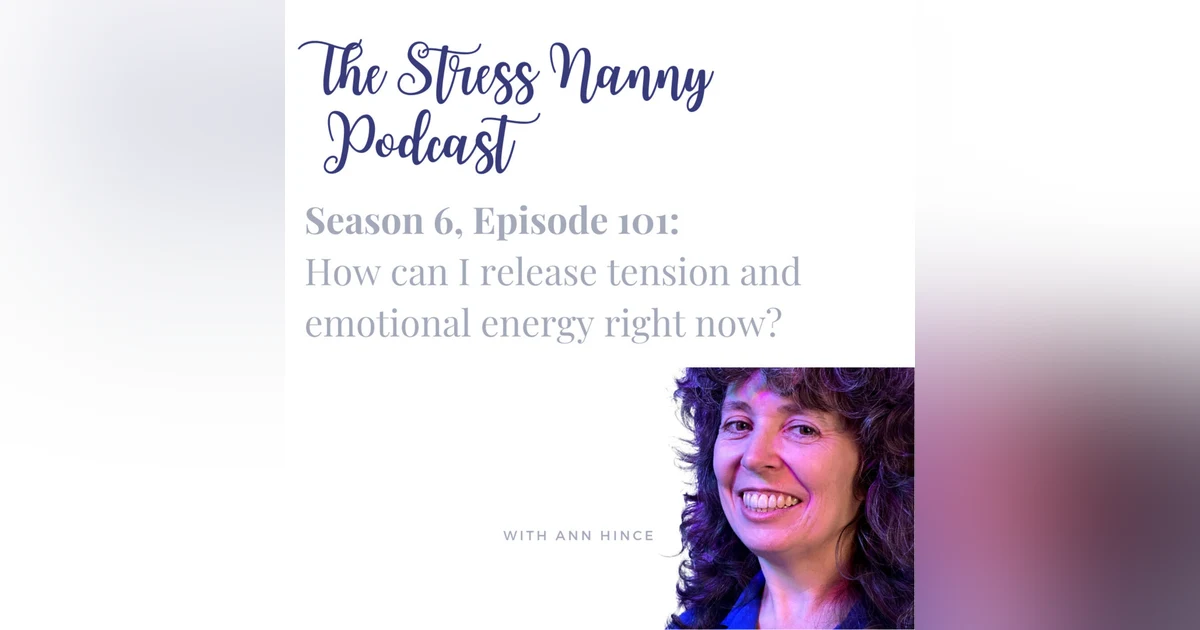
How can I release tension & emotional energy right now?

 Apple Podcasts
 iHeartRadio
 Spotify
 Amazon Music
 Castro
 RSS Feed
 TuneIn
 Podchaser
 Goodpods
 Castbox
 Ann has developed the ability to sense inside her body, and release physical tension stored in her connective tissue, using solely the focus of her mind. She has x-rays to show the physical changes resulting from this inner work - including changing the alignment of her eye sockets, the straightening of her neck, the centering of her lower jaw, and the growth of her tooth roots. Ann wants us all to know that we have this incredible power within us, it just takes going further with practices that you may already be doing. As many of you may know, changing what is on our inside, changes what we see on the outside, so it is Ann's belief that we can not only change our personal world, but also our collective world. Ann has a YouTube channel where she shares her journey, explains the connection between the physical and the spiritual, and will be posting videos of how to change the pressing issues of our time. Her book, A Pathway to Insight, details her journey and breaks down the steps she took to attain what she calls Insight, or the ability to see within the body. You can also find Ann through her website.
Lindsay Miller wants to make your life easier. She's spent several decades navigating really hard things like infertility, marital conflict, loss, moving, starting businesses, parenting, and managing a chronic illness just to name a few. Her secret to making it through those experiences with her health and sanity intact is managing her physical, mental and emotional stress levels. She's passionate about sharing practical tools for reducing stress so that you can use your precious energy to live your best life. Lindsay hosts The Stress Nanny Podcast and teaches yoga and mindfulness courses to kids and adults to make regular stress reduction a way of life. You can find out more about Lindsay on her website or by emailing her: Lindsay@thestressnanny.com
See acast.com/privacy for privacy and opt-out information.
Lindsay Miller 0:23
Hey, this is Lindsay, I'm so glad you're here to pick up some tools to help your family stress less. This week I'm talking to Anne Hince. One of the reasons I really wanted to connect with Anne is because I did an episode on tapping a little while back. And I had some listeners ask questions about it, and provides us with some really specific insights on how tapping works and what it can do for us in terms of releasing stress, recognizing emotion and letting it go. So have a listen. And I'm excited for you to learn from and just like I did.
Welcome to The Stress Nanny podcast. I'm your host, Lindsay Miller. And I'm delighted that you're here to pick up some tools to increase connection and calm in your family. My guest today is Anne Hince and is changing the world from the inside out. She's a spiritual teacher, a public speaker and an author, she has developed the ability to sense inside her body and release physical tension that's stored in her connective tissue using the focus of her mind. We'll talk about this in a little bit. But she has X rays to show the physical changes that have resulted from this inner work, including changing the alignment of eye sockets, straightening your neck, centering your lower jaw, I mean, it's amazing. And she wants everyone to connect with the awareness that they have that same power within them. And it just takes going a little bit further into practices to connect with it that sense of internal knowing, and has a YouTube channel where she shares her journey and explains the connection between the physical and spiritual. She also has a book called pathway to insight which details her journey and breaks down the steps she took to attain what she calls insight, or the ability to see within the body. As someone who is enamored with the mind body connection and the burgeoning amount of both experience and research in this area. I'm so excited to have an joining us today. And thanks so much for being here. Thanks. It's
Ann Hince 2:15
lovely to be here.
Lindsay Miller 2:17
So your story starts out with kind of a traumatic experience, not a kind of traumatic, a very traumatic experience. And as you and I were talking just a moment ago, you talked about how traumatic experiences open us up. Can you go into detail before you share your story about what what traumatic experiences can do for us?
Ann Hince 2:39
Yeah, well, I think of us very much as a signal, like the whole of us is a signal that we are emitting to the universe, and we're attracting back based on that signal. So as part of that, if we're experiencing trauma and childhood, which is very much a negative rate. I think that opens us up to also the opposite at the same time. So we have the capacity to also experience the opposite of that trauma. And I think a lot of us who do go down that path of having trauma in childhood as a seeking were seekers. And we do look for ways to find that positive aspect. Yeah, it's
Lindsay Miller 3:18
so interesting to me, because I had a friend once explained it like you can experience something that increases your capacity to feel. And it's like your depth of feeling like if you could feel two inches inside before. And this is figurative more than literal. But in this case, today, it's going to be literal to if you can feel two inches inside of you as a result of an experience, like you get both you get anything that fits in there, right, you get joy two inches deeper, you get sorrow two inches deeper, it's like your awareness just deepens. And that's kind of what you're saying, right? Like your capacity for either either end of if we call emotional spectrum, your capacity increases both ways. Right? And we have we have increased awareness and increased depth and capacity, for sadness, for pain, for anger, for all the things that come with challenging experiences. And then we likewise have a depth for joy, for just just general happiness, for humor for laughter all those things can, can coexist and be deepened as a result of hard
Ann Hince 4:23
things. Yeah, that's certainly one way to look at it. And that's through the words of emotions. So what I've realized through my really deep work is that that trauma is stored inside of us in our connective tissue. Physically, it's physically stored in our connective tissue. So as when that's stored, it's kind of pooling it's an intention to the connective tissue usually on in one area of our body. And the other the opposite side of that is his stretched in it's one sides tense Start up in one side is stretch. So as we let go of that tension we do, we do align more, our body, our physical bodies align more. And in that, in that alignment, we actually more of our true selves. And we're actually we're calling in spirit mobile, we're able to attune to spirit more, which is naturally those more pleasant feelings, pieces, what I tend to aim for, as my goal was always in a piece. So that's what I like.
Lindsay Miller 5:33
Yeah, no, I appreciate you saying that. And I, I study fascia, you know, with my work in yoga. And so what you're saying speaks so much to me, because there are patterns, right, habituated patterns that fascia take, that, like, create these tendencies or patterns in the body that are ones we work with, you know, we have to kind of release and like go up. And so I love the ability that you cultivated to do that without more than just your awareness, just like your focus and your your inner seeing, allowing you to release some of those patterns and let go of that tension. Before we get into that in more detail. If you wouldn't mind sharing just a little bit about your story, to help our audience connect with you on a deeper level. And also, just to give an added layer of meaning to the words that you share with us today.
Ann Hince 6:29
Sure. I had a lot of trauma in childhood, I had two alcoholic parents. So life was hell, in my mind at the time. And when I was 19, I woke up one day and found my mother dead in the bathroom. And so that was a huge trauma for me, and I, I don't need any sympathy or anything around that totally worked through it. But I held on to it for about two decades. So when I was in my late 30s, I had two young boys, I was stay at home mother, and I went to visit my doctor. And he didn't think I should be stressed. But he noticed I was stressed. So he asked me on a zero to 10 level, what my stress level was. And it was a it's an eight. And I knew straight away it was because the trauma from that event 20 years earlier, but still, the tears were still just under the surface. And so it was holding everything in. So he worked with me with this simple technique. It's called EFT, short for emotional freedom technique or tapping. And he taps we tapped together for about 15 minutes. And I walked away from that office being able to tell the story of her debt with no emotion surfacing. And to me, that was magic. Something really had shifted deep inside of me. And that's what I'd be looking for. I tried all these things that, you know, I think a lot of people try and be normal down this route of different different diets and different modalities and things would often work for a few weeks to a few months. And then things it seemed like things would revert back to the way they were before. And it was really frustrating. And I'd see these other parents that stories like these mothers that were so calm, they always seem so calm, and I so wanted that because my mind inside was not calm. So I found this technique, it was really easy to learn. And a couple of days later, we had a 17 year old cat who needed saline injections each day. And that was something I hated. I hated injections of any form. So the first day I did it, my hand was shaking so bad that I knew I wasn't going to be able to keep doing it. So I thought okay, this is a good test for this, this technique. So I tapped I tapped about the fear of hurting my cat. I talked about my memories of injections. And I did the next injection and it slid right in. And every day thereafter. It just slid right in and it was, you know, that was that was it for me. It's like I knew this was a technique that I could do myself. And that seemed to work. So I started using it. I used it on everyday events. So if I felt overwhelmed or stressed during the day, I would I would just tap. And then I also write down all my traumas I could remember from childhood and I would work on wine each night. And I could feel my mind becoming quieter. And at one point, I could look back and say, you know the voice that was in my mind that was always judging me and judging other people. It was my dad's voice. I was just using his words or the words I've been programmed with in childhood. I was just using them on myself and other people. And it was so nice to have that voice be gone. So that was the first step of my journey. And I still use EFT to this day of for things where I'm, I'm kind of overwhelmed with emotion. But at the beginning, the tapping allowed me to get in touch with actually how I felt about things. So To begin with, if someone asked me how I felt like how are you feeling? And I wouldn't know. And I would just kind of deflect it and say, I'm fine, how are you feeling. But it allowed me to get in touch with the emotions that I was actually feeling, which is the first level of awareness. But there's another level beyond that, which is the physical sensations underneath of the emotions. So like, when you're feeling something like anger, you might have tension in the solar plexus, you might have a clenched jaw, those are all the physical sensations that you have associated with the word anger, or the emotion, anger. So that is another layer of awareness that kind of opens up as he started doing this work. Yeah,
Lindsay Miller 10:44
it's so powerful, and it's bringing to mind a couple of things. One, I'm thinking of how practices like this, which are, so the seemingly simple, right, skin sometimes feel not accessible. So we're gonna walk through the exact kind of practice, and Dan's gonna walk us through what that looks like and how to do it. But one of the things that I'm also thinking of is how current research is starting to catch up with this wisdom that's just kind of been carried, carried down, or, you know, shared, shared in more familiar ways, or in settings that are just a little bit more comfortable, or, you know, not as clinical. And I hear you saying that you did tapping with a doctor at first. But I love that, you know, the, the research that we have on mindfulness right now say around emotion and how an emotion comes up that often triggers old emotions that haven't been, you know, that are still stored that aren't, haven't been released or haven't been processed, and how, you know, Dan Siegel has a ton of work around this, and how, when we, when we become aware of that, we start to recognize all the ways that emotion is kind of running us, you know, or we're just reacting and responding, like you mentioned about, you know, You're conditioned and pattern responses, and how so often, that's the place we're operating from, right this like place of complete reactivity to the emotion. And a lot of times, we might be scared of feeling it, we might not know what to do with it. And I love that you come to a place where you can approach it with a level of neutrality and just accept the emotion, accept the experience of it in the body, and then process it such that there's not a fight because that fight gets in the way an awful lot, right?
Ann Hince 12:27
It does, it does. And that is the key part of all this work. And that's what EFT is doing. It's, it's bringing out what you're feeling right now. And it's accepting it and the tapping actually releases it from being stored in the body. I don't think it's totally clear how it does it yet. To me it's bringing it's creating an energetic interrupt into the connective tissue where it's stored in the body. And I don't know that that's official that it's stored in the body that way, like through research, but through my knowing that's where it's stored. And as you're tapping through these emotions that you're feeling right now, in the present moment, it clears out that emotion and a memory of a similar feeling from the past may come up. And then you can work with that. And that's how you unravel the onion. Because, yeah, everything we're experiencing right now. And the emotions we're experiencing right now, we are replaying emotions that got stored in us in childhood. And we just attract events and circumstances that allow the same emotions to come back up again. That's just coming back up so that we can notice it, accept it and release it.
Lindsay Miller 13:44
Okay, and that is powerful. Let's say that again. Well, you say that again, because I can't see it that well. But I mean, this goes back to this, your current your initial teaching around us being a signal and putting out we're, you know, we're putting out a signal that's kind of bringing things and experiences to us. And in meditation and mindfulness, there's this idea that when you are like churning your garden, and rocks are coming up, like it's on purpose that the rocks are coming up, right, it's so you can clear your garden. And a lot of times we will fight the rock and get frustrated that the rock is there. But the idea is like, we'll just be glad it's coming up, because it's not there anymore. You know, like you cleared it. And so something else can grow. And it's reminding me of that what you're saying, because if we do keep kind of spinning around the same patterns and the same emotions and the same experiences, we we aren't in a position to grow something new simply because we're stuck. Right?
Ann Hince 14:43
Right. Absolutely. That was one of the fun things of moving along this journey is once you clear out the old, new thoughts arise, new thoughts that you've never experienced before and that's really fun to experience. So yeah, a lot of us have all these emotions, especially these days, there's so many emotions arising for us to look at and to let go. But a lot of times we suppress them, or we ignore them, we push them aside. But when we do that, they haven't gone from our body. They're still inside of us, and they're still emitting a signal. So if I've got something like heat inside of me, I would much rather look at it and let it go. So it's not in my body anymore, then suppress it and keep it there and know that it's still emitting a signal and attracting back things that make me want to heat. Yeah,
Lindsay Miller 15:38
yeah, that's so powerful. And you know, one of the videos of yours that I had the privilege of watching, you talked about that and how, you know, a lot of times we will shove it down like, I don't hate this. I'm not I don't want to feel that I don't want to feel that. But then once we allow it and say, Okay, this is coming up, this is actually what I'm feeling. We can connect with the energy of it, and then release it. So can you walk us through what that looks like physically? Like what an EFT session for you looks like?
Ann Hince 16:07
Sure, before I do, let me just say there are 1000s and 1000s of videos on YouTube and other places about how to do EFT. But a lot of those videos and now have kind of morphed into the more positive thinking arena. But the power in EFT is actually working on the negative. Now we've kind of been trained that we should be positive and not negative. But when we're trying to be positive, we actually suppressing the negative. So EFT works on the negative, it's a negative that is stored in the body, without the negative from our past stored in the body, we are naturally positive. So the positive is already in there, we don't need to tap it in. But we do need to let go of the negative. So what you're starting out with is, is wording, you want to try and bring the emotion up into the physical body. If you're experiencing a trauma right now, you don't need to use any words because it's already in the body. So I used to tap on my son, if he had nightmares, I would just go up and tap on his I would tap on his body you'd asked me to, and it would just let the emotion go. And then he gets there. It's Okay ma'am, I'm done. And you can go now. And he would just fall back to sleep. So. So the words you're using to bring up the emotion. So you start by tapping on what's called the karate chop point, which is the the side of the hand where you would do a karate chop. And you say words, and in my mind, I've kind of changed the words. But I would go with a traditional here. You'd say something like, even though my dad was shouting at me, I deeply and truly love and accept myself. And you say it three times. Even though my dad was shouting at me, I deeply and truly love and accept myself. Even though my dad was shouting at me, I deeply and truly love and accept myself. And then you shorten it. So I would just use the words my dad was shouting at me. And the first point is the crown points on the very top of your head where you have the little cowlick where your hair changes direction, and you tap gently. Not so gently that you can hardly feel it but not so firm that you're going to hurt yourself. And you'd have about five to seven times at each point. So my dad shouted at me. And then the next point is the beginning of the eyebrows. So you actually touching your eyebrow right at the beginning. And my dad shouted at me. And then the next point is on the side of the eye, the bone on the side of the eye, my dad shouted at me. The next point is the bone underneath the eye. My dad shouted me. Next point is underneath the nose on the upper lip, my dad shouted at me. The next point is the chin underneath the the lower lip in that little dimple there, my dad shouted at me. Next point is the collarbone points. There's like a little dimple underneath the collarbone. In there, my dad shouted at me. And the last point is about four inches underneath the arm where your bra strap goes across. If you have one, my dad shouted at me. And then you take a deep breath and let it out. And then you ask yourself, if things have changed, you can start out by giving yourself on a 03 10 level how how much emotion do I feel when I think about my dad shouting at me, and then see if that number has dropped. Or you can just see if something's shifted, it's still there if the emotions still there, or if another thought came up maybe a memory of my dad shouting at me. Or you can ask yourself this deeper level question. So what am I feeling about? My dad shouted at me shouting at me. And it might be that it was scary. And if it was scary, then I'd start tapping again. I was scared when my dad shouted at me and then I would go through that again. One of the great things about EFT is actually no, you know, you can tell if it's working, there's multiple things that can happen. So the obvious one is the voice changes tone as you're letting go of that charge. So you might start out with with, like a really high pitch voice or a lot of energy in it. And as you start tapping, you'll relax, the energy will go and it'll become like you're reading from a book. But other things can happen, you might start yawning, you might burp, some people burp, you might get really tired, you might cry, right? All those a release of energy in the body. And you know, at that point that your signal is changing. So every time he let some of this emotion go, you're changing the direction of your future, because you're going to attract something different back. So it's as easy as that. It really, it's just very powerful. And I think some people overlook it, because it's so simple to do. Yeah,
Lindsay Miller 21:00
yeah. Well, and now that you're describing it, I'm like, Yeah, I had a friend that tried to teach me this probably 10 years ago, and I was like, okay, you know, just one more.
Ann Hince 21:10
You can just do it, you can just do it on single words, I spent, I think I did 15 minutes on the word love one time, just to see what came up, like the memories that came up around the word love. And it was very eye opening.
Lindsay Miller 21:28
I bet so you can just do you just say a single word. So instead of like an experience, where you just said my dad shouting at me, you would just say love and do the same process?
Ann Hince 21:37
Yes, um, it could could be someone's name, right? It could be a name of a child or name of someone who's passed or the name of a spouse or someone that you're having problems with, right, just tapping on that name, your subconscious mind will bring up all the associations that it has stored around that one word. So to me when I was doing love it brought up it brought up my mother a lot. And what I experienced from her is not really what I would like to experience from the word love. So it's really eye opening to realize that even when we're talking the words like so if I say the word love to a whole bunch of different people, every, every person, it's going to mean something differently inside their bodies.
Lindsay Miller 22:24
Yeah, okay. So this is another part of your work that I'm glad we're talking about. Because when I was reading it, it really resonated with me, because I'm a big fan of words and using words intentionally and really connecting with all that comes with the word, right? Because a lot of times, we might just use the word flippantly. And we don't necessarily connect with the baggage that might get carried along with it. And you talk about words being again, part of the signal that we send out, right, the signal that is us, and like how when we use certain words and interacts with other people in a different way maybe then interacts with us and how when we have certain memories around a word, and we use that word, it impacts like our felt experience in that moment, right?
Ann Hince 23:11
It does, it impacts everyone differently based on their experience, what they've stored in their body. Yeah, I mean, just think about the word hospital, write someone might might work in the hospital, in which case it they've got all the associations around work, someone might have died in the hospital, and they've got all their associations around the memory of that person, right? Someone might have had an operation. So that one word is going to bring up different different signals and every person who hears it, yeah, so it's a very, very powerful
Lindsay Miller 23:43
so and then so talk to me about it in terms of the EFT because you're saying with certain words, you just tap for those words to kind of clear or come come to connection with, like, what that word means to you, or what it brings up in you? Because maybe you didn't have an awareness of it before? Is that what you're saying?
Ann Hince 24:01
Well, it will neutralize it. Okay, if we, if we work around all those, in my book, I've got a table of different words, that will probably have a charge for a lot of people, most people and if you clear out the energy, the memories around especially negative words, you know, like vile, disgusting, hates all those words, if you clear out the energy around them, then you're gonna get not going to get triggered. Right? If if you experience my parents were alcoholic, right? The word alcohol or alcoholic means more to me than it does to someone who's who didn't have parents who were alcoholic, right? So if I can make that word neutral to me, then I'm not going to get triggered. And we're all so triggered about all sorts of things right now. So can you imagine if we all let go of the fear we have around climate change, right, the fear of fires of droughts of hurricanes of tsunami As of, of all those things, if we made those words neutral to us, then we wouldn't need to experience them again, right, we wouldn't be putting off a signal, we wouldn't have to attract experiences again. So that we have, we can feel that fear. And for me that fear was instilled in childhood, we learned about climate change in school, we weren't allowed to, or there wasn't a way to express the feelings, the emotions around it and let it pass through. So I know I stored it. I was pretty scared, petrified about what the future held. So now we're we're experiencing it, because we've got that signal and reliving it.
Lindsay Miller 25:42
Yeah. Oh, this is really fascinating. And talk to me about it in terms of kids, because I heard you say that you helped your son with this. Do you recommend like parents help kids with it to a certain age? Do you teach kids how to do it on their own? What what do you feel like is the best practice when it comes to connecting with kids around EFT?
Ann Hince 26:04
All of the above? And it also depends on the child, right? I think as long as they're young, you can absolutely do it on them, use their points, just do it gently. I was on an airplane flight one time and there was a mother with her child who was just screaming, you could tell he didn't get his nap. And he was in his mother's arms and just screaming. So once we leveled off, I asked the husband if he would change places with me. And I asked the mother if I could tap on her baby. And I just gently tapped on him for a couple of rounds. And he just relaxed and fell asleep. And yeah, the rest of the people on the flight were very happy. Very loud. So yeah, it's very powerful for children, because they're in the moments, right? They're feeling the emotions right then. So if you can just tap with them and let those feelings flow out of their body, they're not holding on to them. And they're not programming themselves, right? If we tell a child to stop crying, and they do as they're told, and they hold those emotions inside of them, that their programming, they're being programmed, and they're going to keep replaying that signal. And one of the things I say is the tears that we hold in as children, they're still all inside of us. And we haven't, we need to let them go. So I shed a lot of tears when I started this work. But for children, if we can let those go in the moments, so they're not programming themselves, I mean, the future is just going to be different for them. But at some point, they can start learning to do it themselves. I have a friend who has two children, I think like 10 and 13 or so and, and they know how to do it. They know how to catch themselves when they're getting emotional. And they'll remind her when she needs to do it when she's getting emotional. And it's going to be fun to see how they're how they manage when they're adults, because they will be very different. Yeah,
Lindsay Miller 28:06
yeah, that's exactly how I feel about mindfulness for kids too, is that when we teach them when they're young, that's skills in mindfulness. Like when we're helping them to approach a situation with neutrality or have openness, we really do them such a service in adulthood, right? Because they've built their foundation on this place of resilience. So I love the idea of adding EFT to that resilience toolkit, so that they can take that with them and give themselves the opportunity to just move through life without the same kind of baggage that, you know, a lot of us move through.
Ann Hince 28:39
In general. Indeed, yeah.
Lindsay Miller 28:43
So let's talk about this deeper knowing. So you practice tapping, you've done tapping for years and years, and you you over time start to connect with an internal sense of your body. That's a felt sense. That's different than what most people have talked to us about that.
Ann Hince 28:59
Yeah. So there was an intermediary step there. So once I became aware of the physical sensations underneath the emotions, then I started doing something called feeling of feelings. I'd been in the group where this guy would say, you don't need to meditate. It's all about feeling your feelings. And he would say that every week and at that time, I was doing the EFT so I was becoming more aware. And I started to think, Okay, well, maybe I should actually try and do what he says, because I didn't know what he meant. So I had to work it out, because he didn't explain it. So I would stand at the kitchen sink and as I was doing the dishes, I thought would come up and I wouldn't notice that I it was an emotional thought it had some feeling behind it. So then I would hope I would actually become a statue. I would stop what I was doing. I would hold myself still I'd even hold my breath. Because I wanted to feel where that sensation maybe that sensation of of frustration was inside my body, right normally You'd like it for me, it'd be mostly in my stomach area. So I would hold my breath, and actually hold that feeling. It's like, okay, and I would talk to it, because they wanted to feel it, because that's what I was trying to do feel my feelings. So I could feel its frustration, I can feel it, it's tension inside my abdomen, it's like, okay, so I would talk to it's like, okay, I can feel your frustration, I can feel you right there, can you just stay there, it's okay, I'm gonna let I just want to feel you, I just want you to express yourself. So I would hold that until I needed to take a deep breath. And then I would take a deep breath, I would think the thought again, and it's okay, if something changed. And normally, something would have shifted a little bit, it might have been a different, slightly different place, it might not be as intense. And they would do the same thing. Again, I would just hold myself like a statue, feel it, talk to it, and let it pass through. And they would just keep bringing that thought back up until there was no emotion attached to the thought anymore. At which point the thought is free, right? That that gives you freedom, and the emotion is dissipated and body. And then I would carry on with the dishes. And I would wait until I felt another thought like that. And do the same thing was it made for long sessions of dishes, because it took a while to do. But it kind of it really made me more aware. And then I would start doing it on the sofa in the evenings. And I would bring up all these collective traumas I would work through 911 and the Loma Prieta earthquake and the tsunami and different things that all had a lot of emotion inside, and they would do the same thing. And then at some point, I noticed that as I was feeling that tension inside and and it would subside at some point, I noticed that I could actually keep my awareness where it was on the inside. Which is really, it was really weird. And it's really weird to say because I had never heard of anyone doing this didn't make sense. So but I knew I knew things, I knew I was on a path and that everything happened was supposed to happen. So I thought, Okay, this is supposed to happen is just the next step along the way. So then I started moving my awareness inside around inside, and I would find a place of tension. And I would hold my awareness on it, just like I was doing on the outside with the emotions or with the feelings. And I could feel it dissipate. So if I just kept doing that over and over again, and at some point, I could actually put my awareness inside my head and find my face. And I would do the same thing there. But this time, because it was so close to my ears, I could actually hear and feel the tension in the connective tissue release, didn't know what it was, I didn't know it was the connective tissue at the time. But it sounded like fabric ripping. Again, it was really scary the first time because it's like, Oh, am I hurting myself. But then again, I realized, okay, it's supposed to happen, it's the next part of the journey. So then I just started doing it more and more. And it's almost been exponential, like the amount of tension at release now is like 1000 times more than when I first started doing it. And that has worked has has resulted in the changes in my skull. Because I can actually feel sometimes feel the tension in the bones dissolve and let go. So that's what must have resulted in the structure changes in the skull.
Lindsay Miller 33:32
Which is amazing. I know. So I've seen the X rays of this and how the difference is astounding. I mean, how did you how did you first get both X rays? Did you go in knowing like, hey, something's shifting, I want to get a before and after? Or how did you like how did you do that?
Ann Hince 33:51
Well, I've been having orthodontic work for like the last decade and a half. So it was it was one I had eight years ago, I had that one already. And then they redid X rays this last year. So so I got to see them side by side. It's like, whoa, that's quite a change. But it makes sense when you think about it. I was, you know, when I first started being able to put my awareness inside my face. And my head is like, I became aware of so much more tension and pain even that I had not been aware of before. Like because at each level, we release we're showing the next level. And I had so much pain inside my left cheek that I could only put my awareness on it for a second or two because it was so painful. But that's because my body was so unaligned so twisted. And so there was so much tension holding it out of alignment. So as they've been releasing this tension and it was working while I was doing EFT as well. I just wasn't aware of the depth of how much it was working. It's it's more it's a lines my body more. So there's less tension in there.
Lindsay Miller 35:03
Yeah. And you were saying you're working on it in terms of scoliosis too, right?
Ann Hince 35:07
Yes, yeah, my neck is definitely straightening up. But there's more work to do. Because, you know, as I go inside, I can feel the tension. So, wow.
Lindsay Miller 35:17
So in your thing as people practice this, right, and as they're starting to cultivate awareness, not to expect to have this kind of internal knowing that you cultivated like, not everyone will get to that point. So it doesn't mean you're doing it wrong, or you're not doing a good job if you don't get there. But with further and further practice, there's potential that you work, is that right?
Ann Hince 35:38
Oh, yes, it opens up more and more awareness, it's definitely levels of awareness. And because I was not aware at all, when I started. So it's opened up to a point that I didn't know was possible. So when I had my group, I had a tapping group before COVID started. And we used to do this exercise at the beginning, we would all sit in a circle and close our eyes. And I would play these chakra chimes. So it's an I would just have asked people to listen to the chimes. And then at the end, we would describe what we heard or felt. Now, some people would only hear them with their ears. But on the other end of the spectrum, some people felt the the sound vibrations deep inside their bodies. So when you hear that other people have that different experience, then you can understand that there are different levels of awareness, even if you don't have them right now, the potential is there. So now you know that people have these other levels of experience with sound, which also relates to words, right, if someone can feel sound vibrations deep inside their body, then they're going to have the experience of listening to music or to to words at a different level, they're going to very different experience than someone who could only hear with the ears. So I think it's nice to know, it's useful to know and you can try that yourselves, right? How, how deeply Do you feel music? Because when you could feel it really deeply, it's almost orgasmic. Right? It's just, it's through the whole body. And it's just a totally different experience. And it's fun to aim for that. Even if you don't necessarily get there straightaway.
Lindsay Miller 37:26
Yeah, yeah. No, that was great way of putting it. I like that example. Because it's very just real. We, you know, everyone hears music, and we can all connect with the different levels of hearing it. And yeah,
Ann Hince 37:41
and part of the thing that's going on these days is like, everyone thinks that they're aware, right, we whatever level we are on, we all think we are aware, because we don't know those other levels. So now that there are definitely differences and awareness in people and some people are more aware than others. It's just we all think we're fully aware. And then we're not.
Lindsay Miller 38:06
Yes, this is that reminds me of teachings from Yeah, Hinduism and Buddhism, where it's like, the moment you think you arrived, that means you didn't you know, when you think you've achieved enlightenment, yet, that's the first clue that you Yeah, that there's still plenty for you to do.
Ann Hince 38:25
I have something Can I can I share something about enlightenment, please. Because I feel it's a process that I knew nothing about, again at the beginning, but at this point, I do know some of what happens. And there's two aspects to it. I know when I was a teenager, and in my 20s, I felt so heavy, like I was carrying the weight of the show of the world on my shoulders, I just felt heavy. And as you go through this, you're letting go of the baggage that you're carrying, you actually feel physically lighter, your step feels lighter. And that itself is a really nice change. And then the other aspect of it because I can actually sense inside I'm not actually seeing inside what I'm doing is sensing inside, so I can sense tension and non tension. And I can sense darkness and light. So as I'm holding my awareness on a place that has tension and letting it go, I can then see oh, it was dark. And now it's light. So as I do more and more of this on the inside, I'm allowing more and more light that was there to be exposed. So it is an enlightenment process.
Lindsay Miller 39:36
Yes. Yes. All and I can tell it's hard for listeners because they can't see your face. But I think from your voice they can tell but just you do exude a light like you just you have a brightness about you. That's really beautiful. So thank you for sharing that. Before we close can I ask you three questions? Sure. Okay, what's your favorite food?
Ann Hince 39:58
Dark chocolate food of the gods, I love dark chocolate. I have some after breakfast every day
Lindsay Miller 40:05
knows what's your favorite way to relax.
Ann Hince 40:09
I can relax pretty easily these days. So just sitting down or lying down, I go inside, and I feel the next layer and I release it. So deeper and deeper levels of relaxation.
Lindsay Miller 40:21
I love that. And then an amazing story from childhood. I know we talked about how there are a lot of moments that were not amazing. So I just want to honor that,
Ann Hince 40:31
too. Thank you. I did have one experience. I lived lived in different countries in childhood. And one of the countries I lived in was Hong Kong. And I went through a small international school there called Kennedy red Jr. School. And there was there were two twins there. I'd never met twins before. And there were two boy twins. They were a little older than me. And their names were Simon and Duncan. And I was only at the school, I think two years, a year or two years. And that's when I was about nine or so. And then when I was 15. We lived in Bahrain, which is a small island in the Persian Gulf. And we went to this little supermarket that's a little Arabian supermarket one day and they walked around the corner, and there was Simon and Duncan white. So from Hong Kong to Bahrain. Yeah. They didn't recognize me because you know, I wasn't anything special. But they were twins. So I recognize them. So it was pretty amazing.
Lindsay Miller 41:29
That is amazing. Yeah, totally amazing. Yeah. And, okay, talk to our listeners now about your book where they can where they can find your work.
Ann Hince 41:39
Okay, great. Thank you. My book is called a pathway to insight and I talk about these different steps that I took is more of a how to it's like, how would you go about doing this. And I talk about the law of attraction, because I feel that the signal part of us is so important to understand. So that's available from your local bookstore if you order it, or it's available from Amazon. And I do have my YouTube channel where I kind of go into depth on some of the changes and how things went about. So you can find me there. Just look under my name and hints. And I've got my website, which is ant hints.com.
Lindsay Miller 42:17
So many great resources. And you know, your story is so inspiring. And it speaks to resilience, which is something that we talk about a lot on this show just the cultivation of resilience and how it is that you're illustrating with your own story, a lifetime endeavor, right. And a lot of times as we continue to cultivate it, like you brought up there are more and more layers and levels that we can kind of take it to, but the process of engaging with, with resilience and with bringing a resilient mindset into our lives and a resilient body. It makes such a big difference. And thank you for speaking to that today. So beautifully.
Ann Hince 42:54
Thank you for having me. I love these kinds of conversations.
Lindsay Miller 42:57
Thanks again, for listening. I hope this episode was as insightful for you as it was for me. I know with the epic levels of stress right now for everyone, right? For families, we've got kids, adults, we've got teachers, professionals, I mean, we're all just kind of trying to make it right. And so if there's something in this episode that you feel like would serve someone, you know, please, please share it because I feel like her approach is so simple and so empowering, that you can, you know, access it, whoever you are, wherever you are when you need it. And that's the kind of tool we all need right now to make it through what we're facing. Thanks again, for being here. I'd love to have you subscribe, and come back again next week. A few of the other ways that I help families build resilience are with my courses. I teach yoga on Tuesday morning, so you can come start your day with me and help your nervous system start off really mellow. So you can face whatever comes your way. It's from six to 7am Mountain Time. And then I have a mindfulness for grownups class on Tuesday nights from 630 to 730, Mountain Time, where we talk about how to live with intention. So we look at what's going on inside of us emotionally, mentally, physically, what's going on outside of us, or relationships, or life or stress or work, family dynamics, all those things. And then we look at all of those and how to make an intentional choice about how we want to show up in the world. This week, we went over intentions and talked about the way we want to show up this year, the way we want to live. It's a really supportive group of women who are trying to live on purpose. And then I also have my kids mindfulness coaching, which my kids described as a fun way to learn how to be calm, not like those boring ways. So if you want your kiddo to enroll in that, please reach out and get on the waitlist. I know kids are so stressed right now. And I just want them to have what they need. And I want them to be able to learn those skills of mindfulness in a fun and playful way. And I have an easy time connecting with kids. I can make it a fun and meaningful experience for them to learn. So reach out and I'll get you on the list. And I think that's it. Thanks again for being here. Until next time!
Transcribed by https://otter.ai