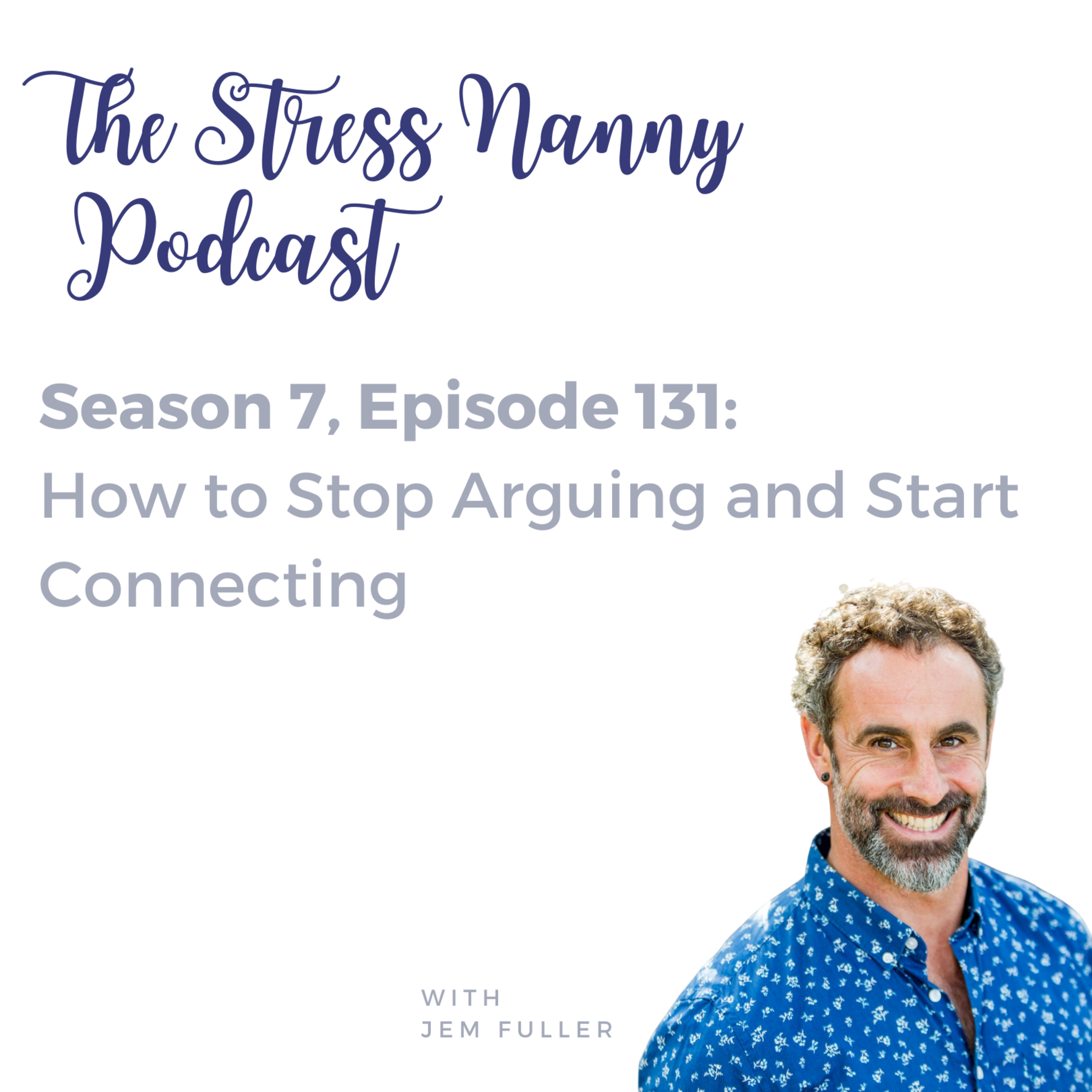
How to stop arguing and start connecting


 Apple Podcasts
 iHeartRadio
 Spotify
 Amazon Music
 Castro
 RSS Feed
 TuneIn
 Podchaser
 Goodpods
 Castbox
 In this episode, Conscious Communication expert Jem Fuller and I talk about how to decrease arguments and build connection. While this kind of mindful communication doesn't come naturally to most of us, it can be learned and the result is relationships that feel more connected and steady. If you are looking for ways to improve your communication with your partner and/or kids, this episode is for you! The link to the remote control I mention in the conversation can be found here.
Jem Fuller has lived a colorful, global life. From barefoot backpacker to corporate leader, fire-dancer and traditional tattooist, kindergarten teacher to motorcycle courier, masseuse and reflexology to laborer and travel consultant. Now his time is as partner and father, coach, facilitator and retreat leader. He is the author of the recently published book, The Art of Conscious Communication for Thoughtful Men, and can be seen delivering his TEDx talk on YouTube. You can connect with Jem on his website.
Lindsay Miller is a kids mindfulness coach, mindfulness educator and host of The Stress Nanny Podcast. She is known for her suitcase tricks and playful laugh. When she's not playing catch with her daughter or rollerblading on local trails with her husband, you can find her using her 20+ years of child development study and mindfulness certification to dream up new ways to get kids excited about deep breathing. Having been featured on numerous podcasts, platforms and publications, Lindsay’s words of wisdom are high impact and leave a lasting impression wherever she goes. To download Lindsay’s Mindfulness At Any Age Guide click 5:92c99b91-42a7-4655-ae85-631f15636dd3">here. To rate the podcast click here.
Lindsay Miller 0:07
You're listening to The Stress Nanny podcast, and I'm your host, Lindsay Miller. I'm here to help you keep an eye on your family stress levels. In our fast paced lives, the ability to manage stress has never been more important for kids or adults. When it comes to stress, we have two choices, we can decrease stress or increase our resilience to it. Here on the number eight ranked stress podcast, I interview experts and share insights to help you do both. When you tune in each week, you'll bring your stress levels down and your resilience up so that stress doesn't get in the way of you living your best life. I'm so glad you're here.
Hey, this is Lindsay. Thanks so much for joining me on the podcast today. I'm so excited to share this conversation with Jem fuller with you. We talked about conscious communication. So learning to communicate on purpose and like what some of the hurdles are to that as well as what some of the practices are that can support us in our efforts to communicate more consciously. I came away with so many insights and it was a fascinating conversation. So I hope you enjoy it. On to the episode.
Welcome to The Stress Nanny podcast. I'm your host, Lindsay Miller, and I'm so glad you're here to stress less. I can't wait to introduce you to my guests today. Jem Fuller, Jem has lived a colorful global life from barefoot backpacker to corporate leader, fire dancer and traditional tattooist, kindergarten teacher to motorcycle courier, Miss Seuss and reflexologist to labor and travel consultant. Now his time is as partner and father, coach, facilitator and retreat leader. He's the author of the recently published book The Art of Conscious Communication for thoughtful men, and can be seen delivering his TEDx talk on YouTube. Jem, thank you so much for joining me today.
Jem Fuller 1:55
No, you're welcome, Lindsay. Thank you for having me on your show.
Lindsay Miller 1:59
So one of the reasons that I was super excited to talk with Jim is that his focus is on conscious communication. And I am so enthusiastic about that topic. But there may be listeners who are listening right now, right, Jim, who said, I'm not actually even sure what that means. Can you tell us what conscious communication is?
Jem Fuller 2:18
Yeah, absolutely. I mean, essentially, communication underpins effectiveness and our experience of life, in almost all aspects of life. So our ability to communicate initially with ourselves, although we don't pay too much attention to the quality of our self talk, but I think it's ultimately important, but then our ability to communicate with, you know, our partners, our children, our parents, and beyond that, you know, our community and in the workplace as well. And I've noticed over the years of coaching that quite often humans trip up in communication, you know, so we could have two people who love each other, but they're missing each other in the communication, or two departments in an organization that are on the same organizational mission. But they're at loggerheads over something, and it's quite often just the miscommunication where they're coming unstuck. So I think communications, really important and conscious communication, when we're more conscious of something we're more aware of, of that which we're conscious of. So just being more aware of the communication itself, you know, what is the purpose of the conversation we're having and, you know, seeking to understand the other person rather than rather than queuing up to speak to them and just just being more aware of the communication and, and what we're trying to achieve through that.
Lindsay Miller 3:43
Yeah, that's so well put, and I love the ramifications that you shared, because oftentimes, we I mean, we're just communicating maybe out of reactivity out of habituated patterns, right. And like you said, it has such a broad impact, whether we're in the family, the workplace, you know, just with a with a significant other. There are so many ripple effects from the communication that we put out every day. And if the more we become mindful of it, the more we can really be intentional about what ripples out from us.
Jem Fuller 4:15
Yeah, yeah, absolutely. You know, there's so many, you know, times when you walk away from a piece of communication, and you're like, Oh, I could have done that. That's not what I meant, you know? And have you got a dog in the background Lindsey? Love it. I live on a farm and so at this time, you won't hear anything but quite often during the day when I'm in a conversation with someone you can hear the birds or the sheep or something on the farm,
Lindsay Miller 4:45
but much more soothing than than her barking for sure.
Jem Fuller 4:51
But yeah, you know, there's so many times when we walk, we walk away from a conversation thinking, Oh, I could have done that better or that's not what I meant to say or, you know, my emotion. Things got in the way or, you know, my thoughts were racing. And so the ability to, as you said beautifully to be more mindful, which is more conscious, to be more present in the communication to be more calm, you know, is it's a skill that we can cultivate, you know, we can get better at this. So yeah, there's, I've written a book about that. And there's, there's lots of techniques and strategies in there to help people become more mindful and more conscious in the communication.
Lindsay Miller 5:31
Yeah, and I'm so excited to dive into those, because I think there's so much that we can do that's relatively simple, right. And it's like bringing the awareness and attention to it. But with the consistent practice of simple things, there's a huge opportunity to uplevel our communication, right?
Jem Fuller 5:51
Yeah. And to uplevel the quality of our experience of life in general. And I couldn't agree more, it's the small 1% simple things that we implement and create to become habitual, that over the longer term really make the difference. You know, I think you can go to an amazingly inspiring and light bulb moment, conference, you know, and see some amazing speakers and have a really, aha weekend. But if you come back to your day to day life, and don't make any of those small, habitual changes in a year from then nothing's happened, nothing's changed, nothing's happened. Whereas if you pick it, pick some, some just really small little moments in each day, that don't take up much time. And if you can find a way to create habits, and there's strategies around that as well, that's when you really start to enjoy the benefits of, you know, enhancing your experience of what it is to be you in the world around you. You know, and it's it is very doable. I've been, I'm a living example of how that's possible. I went from a life that wasn't like that, but found ways to create new habits and really enjoy, you know, for the most part really enjoy my life. So,
Lindsay Miller 7:12
yeah, well in that's, I think one of the most powerful parts of your story, right? Is that conscious creation of a life through those study changes? And like the intention that you set? Will you share a little bit more I know, we went into your background in the intro, but before we share the tools, will you just share a little bit more about your journey kind of through those various, like vocations and experiences and opportunities and kind of maybe encapsulate the evolution of your own conscious communication? And then we'll get into the tools?
Jem Fuller 7:48
Yeah, absolutely. Oh, look, you know, from from the, from the outside looking in, you know, I was just a while I was addicted to travel, when I was younger, in my younger adult life, I spent from my late teens, right through my 20s, and into my early 30s, just passionate about going to as many different cultures and countries as I could. And I was really interested in going to places that were very foreign to where I grew up, I wasn't so much interested in traveling to places that were similar to where I, where I grew up as a kid. So that had me traveling all around the world and going to some wild and wonderful places and earning money anyway I could to, to keep funding my adventurous spirit. And now with the benefit of hindsight, I looked back and, and can understand a little bit more psychologically and emotionally, why I was drawn to these very different cultures. And it was about connection, I was really passionate about cross cultural connection, finding what I had in common with people who looked very different to me, who grew up culturally very different to me, you know, maybe in a different faith, or religion or belief and eight different food and geographically lived in very different places to me, and I was always curious to sit and talk with these people and find out what we had in common. So it was really about this human connection piece. So that was, that was all lovely. And, you know, on my, on my journeys, there's been a couple of identity crises, where I didn't know who I was anymore. And then there was becoming a father. And the stereotype, not the stereotypes, but the, the archetypes that I played into, to try and find how I was relevant. You know, it's interesting for being a man in the parenting situation because you feel a bit like a third wheel. You know, you can't carry the baby inside you. You can't breastfeed the baby. Essentially, the baby would be fine without you. So you kind of like oh, how am I important here? What can I do? And so one of the one of the archetypes that Men, some men gravitate towards his provider. So you know, I put my head down and I worked really hard to provide and, and I thought that's all I needed to do to be a good man. I didn't realize there's so much more to being to being a good man in terms of partner and all the other roles that we play. But anyway, the deepest story underneath all of that, Lindsey is that I had been harboring a self belief racket really, subconsciously, that I wasn't good enough throughout my life, that I wasn't enough. I've since found out since studying human behavior and working with lots of people. This is quite common. And this is where the imposter syndrome comes from where people think, Oh, am I do I deserve this success or, you know, and this worry that we're not good enough, or we're not smart enough or fast enough, or I'm not a good enough parent, or I'm not good looking enough, or I'm not popular enough, all of these worries, can then play into self sabotage, you know, can play into overwhelm and procrastination. Lots of, you know, kind of less than desirable patterns that we can fall into. And it wasn't until I was in my early 40s. And I had my midlife awakening, I call it some people call it a midlife crisis. I love my midlife awakening, really. And that's when I realized, wow, I've developed a really strong belief that I'm not enough. And, and I was deeply unhappy. Unfortunately, by the time I was in my early 40s, and I found this out, I ever most my marriage had gone too far south. And we'd been desperately trying for years to rescue it. Because nobody falls in love and gets married thinking that you're going to break up one day, you think you're going to be together forever. So that was really sad. And I lost my career, I lost my house, I lost everything, except my two boys. Thankfully, we had my kids week on week off, I still do. So I had my I had my two boys and everything else I'd lost. And I'd lost my sense of self again, and had to build that up. But this time, I was determined to, to rewire my belief, my sense of belief. And I went to work on myself and convinced myself that I am enough, just the way I am. And that changed everything, to be honest.
Lindsay Miller 12:43
That's so powerful. Thank you for sharing and being so authentic about it. Because I think sometimes we can think that mindset shifts are for like times when it's convenient. But what you just described was like a time of deep necessity, right? When you made that ultimate shift during your awakening, and I love the just the humility in it like that, sometimes life invites us to those those mindset shifts, and it's really, really hard, right? It's not like, oh, when we have time for it, it's like, no, the rubber just met the road, and you have pretty much sometimes no other choice, but to kind of rearrange the way you're conceptualizing yourself and your life, or, you know, kind of keep sinking. And I just really can honor the effort that it took, like, in that deep vulnerability to make so many changes, you know, internally, emotionally, and then have those reflected externally. Yeah,
Jem Fuller 13:44
thank you. I'm grateful that I had my two boys there, because that was really, you know, the piece that that gave me the determination to do the work to rewire my neurology because it wasn't easy. You know, people think I can go to a Tony Robbins weekend workshop and everything will change. Yeah, no, it won't. You know, you've got to do the work. And but because of those two humans, those two people that we love the most right, that we would do anything for our children. And so thankfully, I had my boys there, and I was like, I need to do the work, to love myself, so that I can stop making it all about me and start serving and start making it about other people we quite often get in our own way, you know, we're, we're, we have the intention to contribute to the lives of others. You know, whether it's our children or our parents, our family, or perhaps for some people, their community. And then for some people, they want to contribute to the lives of others more globally. So they're on a mission to do their part to help make the world a better place. It doesn't actually matter, the scale of which you're driven to do this Even if it's just intimate just for your kids or your parents, but using that, that leverage to say, right, what am I prepared to do for these people? You know, so I was prepared to, to change my beliefs around myself. And that looked really boring. It was high repetition, every day, speaking kindly to myself out loud many times a day, Jim, you're exactly who is supposed to be. You are completely enough of everything to be who you are. You are good enough just the way you are. And I said this Lindsey out loud, hundreds and hundreds of times a day every day. And I didn't even start to notice the changes for at least six, but more to 12 months of high repetition every day. And then the neurology started to wire together just like I'd read. It does in the books that I'd read about changing the way you think. And it started to happen. And I started to believe it. The first six months, I didn't even believe it just to my rubbish, or I'm good enough just why I'm no I'm not I should be more like this, or I should be more like him. Or, you know, I didn't even believe it. But I had read these books about rewiring. So I just, I stuck at it. And then it started to change. And I started to believe it. And then wow, my life really did change. You know, I went from losing my job to creating my dream vocation, the work I do I love and I feed my kids doing something that I love. And my relationships went through the roof. And lo and behold, guess what happened? I attracted this amazing human into my life. My wonderful partner who thinks that I am perfect in every way for her perfectly imperfect, we say, but she loves and adores me and everything about me. You know? So yeah, it's interesting, but but I had to learn to love myself first, before I attracted that person who loves me the way she does. So yeah, everything, everything changed. It's really quite wonderful.
Lindsay Miller 17:05
Yeah, and there's so powerful, there were so many little pearls of wisdom in there in your story. So thanks, again, for being willing to offer that up. I think one of the things that can be so powerful is when we're looking at motivation, like you mentioned, being able to see our kids or grandkids or a partner and saying, like, my experience with this person will be better, their experience will be better, you know, with these conscious choices that I make. And I love the way that you've kind of braided all of that together, like your own experience of life, dramatically shifted. And then everyone in your sphere of influence was influenced by that, right. And then you were drawing in people into your sphere, as a result of those shifts that you made. And I think sometimes we can, again, have this desire for good things for the people around us. And we can go about it a little backwards. And I don't know if you would agree, but we can, we can try to make those external things and try to try to kind of force them or bring things in. And what you're describing that I'm hearing is like it was the internal change that then like kind of just brought in all the things that were were for you. But it wasn't until that compassion was flowing from you, like to yourself and then overflowing out of you that those things found you like it wasn't enough for you to try to just offer it up. It had to be like overflowing and filling you first in order for those other things to kind of start swimming in your circle.
Jem Fuller 18:44
Yeah, that's so beautifully said. And I believe this to be true. I believe that you know, to improve the quality of your life, the place to start is to improve the quality of your relationship with yourself. You know, you can busy yourself with doing things for everybody else, you know, you can be giving, putting so much effort into always trying to make other people's lives better, which in itself is is lovely, that's a really lovely thing to do. But your ability to do that is capped at the the level of resolution with self because if you're not completely resolved with who you are, and your past, then there's a lot of noise in your mind. And your whole experience of life is in your mind. You know we receive the bits of information from from the environment around us. You know, you hear your baby cry or the sound of your baby crying comes to you in waves and through your ears if bits of information and you represent that sound in your mind. You know when you see someone you know you're receiving bits of information through the law Ah, that comes through your eyes, and then you represent that image in your mind. So very literally, your whole experience of life is in your mind. So the quality of your mind matters. It really does. And this is something that you're not stuck with, you can curate the quality of your mind. And the quality of your mind, the static, or the noise that's going on in there has a lot to do with your relationship with the past. Which is your relationship with self? Who am I? What do I think of myself? How do I talk to myself? Have I forgiven myself or accepted myself? Or am I still angry at things that have happened and the ways that I dealt or didn't deal with those situations? Am I still unresolved, and the more unresolved we are, there's a lot of static and a lot of noise. And that gets in the way of seeing the person that you're sitting opposite, with, let alone, you know, seeking to understand them, and then being able to serve the greater good. So I think it's really important work. And it's ongoing. You know, I don't think you tick a box and go, I'm all good with myself now. And that's done. It becomes habitual. You know, I, it's habitual for me every morning to say my self love affirmations. And I think I'll do it forever. I look at myself in the mirror regularly and say, Hey, Jim, you're alright, mate. You know, your intentions are good. You're exactly who you're supposed to be. This is the radical self acceptance piece. I am exactly who I'm supposed to be. And so you, Lindsay, so is everyone. How do I know this? Well, because reality tells me that you are just the way you are. So apparently, that's exactly how you're supposed to be in this moment. That's not to say that over time, you won't evolve and, and, you know, grow and change. But in this moment, right now, if we could freeze frame time, right now, you are perfectly imperfect, you are exactly who you're supposed to be. And you're enough of everything. To be you. You shouldn't be more like anybody else, because you're not, you know, and this this, this is a light bulb moment that you can then turn into a daily practice. I know I'm jumping forward a bit now into some tools, but you have this light bulb understanding of going, Oh, wow. Of course, I'm enough. I'm enough to be me. I shouldn't be more like anybody else. Okay. And then that can become a daily practice of saying that out loud. Quite literally. It's funny with affirmations, I used to think affirmations were some kind of woowoo hippie, or, you know, Eastern traditional thing, Mantra, you know, and I thought, Oh, that's a bit. That wouldn't do much surely. And it's interesting. Now, years later, having read what neuroscience discovers and finds out about neurology and how they wire together and the neural pathways and all this fascinating stuff, like, oh, wow, affirmations do actually work. And so yeah, they can become a daily tool.
Lindsay Miller 23:17
I love that I had a similar relationship with affirmations a while back to like, no, okay, okay, that's great and all but then really, after practicing them and seeing the benefit, noticing that the difference is, it is like you're saying it's physiological, like the brain changes when we tell it certain things are when we practice thinking or saying certain things. So let's get into it. I loved what you just shared, and I was jotting down notes as you were talking. And the phrase that just jumped out at me was you can curate the quality of the mind, I think I'm gonna frame that here in my office with attribution to you because it's such a beautiful way of putting it and it's completely true. completely true. Like we get to choose what what's in there and what informs our daily decisions, what informs our beliefs about our potentiality what you know, comes across in relationship we get to choose all those things once we make the conscious effort to like, sift through what's there, right and then start the process of curation.
Jem Fuller 24:21
Yeah, absolutely. You know, there's, there's a, there's a myriad of thoughts that just appear and you don't really get to choose them. The thoughts that are just bubbling away all the time, but you do get to choose which ones you want to focus on. And then even vocalize, you know, and I believe it's powerful when you put a thought on vibration, because very literally, your vocal cords are vibrating. So it's, it's, it's resonating on a on a physiological level within your body, but then also outwardly when you speak something out loud. Words are powerful. And in some beautifully mysterious metaphysical way, when you put it on vibration, it's it's going out into the universe, right? So that's, that's quite beautiful. But choose the choose the thoughts that you want to put focus on. And also, you can choose with with volition with intention, you can choose the words that you want to say out loud. You know, that's, that's a choice. And I think for me it was really important and fascinating to pay attention to the self talk. So we're talking about communication, what was the quality of my communication with self like, and when you pay close attention, we are so horrible to ourselves. Sometimes, I was aghast at the words that I was using against myself. You know, when we, when we set the bar, and we try to do our best to achieve something and we fall short of that, the words we reprimand ourselves with a terrible, we would never speak to our children like that, you know, we swear it ourselves, we use expletives where we speak aggressively and horribly to ourselves. You know, and that kind of shocked me. And I was like, wow, if I'm going to repair this relationship with self, I've got to start speaking a lot more kindly to myself. And that doesn't mean that you kind of just accept something that's substandard for you in terms of your values and how you want to live, you can still aim to be, you know, the best version of yourself. But when you for sure, coach yourself in a positive way, you know, more along the lines of, Hey, come on, Jim, you can do better than that. I believe in you, you've got this, you know, it's okay, you tried your best, it didn't work out, that's okay, let it go. But the next time you're in a situation or a conversation like that with one of your teenage boys, you can do better come on, you know, so I'm still holding myself accountable to wanting to be the best version of me that in a kind way. You know, you imagine that you had a sports coach who was firm that kind rather than the sports coach who was abusive? Which coach, do you want to be for yourself? You know, another, another time that I noticed, the way we speak to ourselves is when you get out of the shower, you're on your own, and you're looking at yourself naked in the mirror. What are you saying about yourself to yourself, because sometimes we're horrible. Because of the way we look, change that. Be aware of that and then and change it? You know, I really think that cruelty is always dysfunctional. I can't think of a time when being cruel, has any real function of any positive function, whether it's to yourself or to others. But we are so cruel to ourselves. So I think it's a good first step is to just ease up on that.
Lindsay Miller 28:08
Yeah, no, that's so wise. And again, yes, so many, so many things you said were so resonant and powerful. I love the idea of checking our talk towards ourselves and then about our bodies. And I think one of the things that I notice, when people are first trying to pick up that skill is they'll load on some guilt after they realize they're being hard on themselves. Like, I'm being hard on myself, again, I'm doing it again, I can't believe I you know, like, I can't believe I'm still doing this, talk us through that because I think there's this progression, right, where we we start to cultivate an awareness of what's going on in our thought river like you're describing, and these things are bubbling up without us really paying attention to them. Once we start to notice and we start to see how cruel and and really unkind, we are often to ourselves, we can we can choose at that point also, right? Whether we're saying like, and this is something I'm working on, or, you know, orienting ourselves to and I deserve better than that, or, and, and I'm and I'm going to do that much less than I used to, or whatever it is to orient ourselves toward the growth and the intention that we have to change those things, rather than like getting kind of stalled in frustration or guilt. That those are a part of our consciousness. Right? Yeah.
Jem Fuller 29:29
It's so so true. The, the the brain or the mind is like a wily fox. It's so quick. It's so quick at the, you know, getting stuck back into that little pattern. And it's interesting as you were talking, it made me think of Carol Dweck, who the psychologist to started speaking about growth mindset. And one of her favorite words to add on to the end of a sentence is yet so we would say ah, I'm no good at this yet. You know, I had for me another really powerful practice, which thankfully now has become habitual. So it's not a chore I look forward to it is the practice of mindfulness meditation. And, and really the benefits, the longer term benefits that that we enjoy. From creating a habit of mindfulness and mindfulness you can, I like to think of it in two simple ways, integrated mindfulness, and dedicated mindfulness. So dedicated is when you dedicate time to sit and meditate, essentially, integrated mindfulness is great for people who say to me, Jim, I don't have time to meditate. It's integrating mindfulness into something that you're ordinarily doing anyway. So you can mindfully brush your teeth, you can mindfully drive your car, or listen to someone or anything that you do, you can do it mindfully. And mindfulness is quite simply an attention to the present moment. That's all. Just noticing what you can notice, in the present moment. No judgement, as little judgement as possible, we can't help but judge as little attachment as as possible, just simply noticing it. And this is a skill. And I know mindfulness meditation teachers will tell you that we're not thriving for anything, and you're not doing it to get better at it, it's just being in the moment, which is true. But once you're outside of that moment, again, over time, you do notice that there are some benefits in terms of this curation of the quality of your mind, and the ability to observe anything, including your thoughts. So there you are standing naked in front of the mirror, and you notice yourself, berating yourself. And then you go, Oh, I'm still doing it. And then you berating yourself for berating yourself, and you're getting caught in this loop that you were talking about you and then you have you remember that you have the ability to step outside of that. And just simply notice that mental looping that's going on, and you can very literally remove yourself from identification with it. And just notice it as the same way as you noticed your breath. Or the same way, as you'd notice the toothbrush, or the same way, as you notice the sound of the kids, you know, running around in the background, when they're supposed to be putting on their pajamas and getting into bed. You know, and you can notice it all with less identification, you're less enmeshed in it. And it's like, it's a way to short circuit anything, and to step outside of it to a place of equanimity. And it's become and is becoming a such a beneficial tool for me, you know, sometimes maybe you lose yourself in the emotion of a moment, and you're angry. The ability to be able to step outside of that and simply observe it and not try and change it. Not try and quieten yourself down, not try and you know not try and do anything, just simply notice it. And what happens is that it naturally kind of evolves into the next moment very quickly. And all of a sudden you realize, oh, wow, I'm calm again. That's nice. Yeah,
Lindsay Miller 33:21
yeah. I love the way you you describe mindfulness. I love mindfulness too. And I, in circling back to this idea of communication, one of the ways that I describe mindfulness is knowing what's going on inside of you, knowing what's going on outside of you, and then making a choice on purpose. So like, in any given moment, being able to tune into our emotions tune into who's ever across from us, whether they're tiny or grown up, and then choose, right, like intentionally choose. And in order to do that, you have to have cultivated the ability to sift through all of that, and then communicate from a conscious place, right?
Jem Fuller 34:01
Yeah, yeah, absolutely. You know, our ego, which is apparently necessary, because we've all got one. This sense of identity, who we think we are, is just super, super quick. You know, we take everything personally, immediately. And for a lot of us humans, we're not even aware of this because we haven't had these conversations or listen to these podcasts or read these books. Most people are just literally waking up and then reacting from moment to moment and doing what they do. But I think it's helpful to understand their ego a little bit. You know, I certainly find it quite fascinating and it's a big part of what I teach my clients, this awareness of self. When is it my ego because the ego is fueled by fear. It's a self protection mechanism. So it's gets its petrol from fear and it's Super defensive. And we identify with many things we identify with our thoughts, we think we are our thoughts. Heaven forbid, you're not your thoughts.
Lindsay Miller 35:12
Hallelujah. Right? I mean, hallelujah,
Jem Fuller 35:14
wow. Because those those those terrible thoughts that pop up, that's not you that thought popped up because it was triggered by some external stimuli or internal stimuli due to the way you grew up and the things you were told as a kid and the culture that you were indoctrinated into. And then the media that you see in the social media scrolling that you do, and all the things, all the stimulus around you, and these, these neuro chemical firings, these, these thoughts just appear. It's not you, you know. But we identify with our thoughts, we identify with our ideology, we identify with our political beliefs, we think that's who we are. And then we get super, super defensive over that. You know, I've watched I don't know about you, Lindsey, but I've seen families over the last two years, who loved each other. They were a family unit, Mum, Dad, and kids. And then they identified with different ideas. So one of them identified that it was, they believed that it was the wrong thing to do to get vaccinated. And other family members believed it was the right thing to do to get vaccinated, and they've their ego identifies with this ideology, and they have broken up, the family has broken up, they've disowned each other, you are not my son, you are not my mother. And I don't know whether they'll ever come back together again. And that's crazy. Because that they identified with an idea. You can, you can have an idea without identifying with it, you know, so our ego really gets in the way. And the practice of mindfulness is also the practice of observing our ego, and being less governed by it. And noticing when you're getting very defensive, noticing, when you're getting angry with the person who's disagreeing with you, noticing when you're losing yourself in the moment of a fight. You know, and noticing and go, Oh, wow, ego, look at you go. Defending our idea here. And I know you're trying to keep us safe, but we're safe right now. There's no lion coming to aid us. You know, we're actually okay, take a breath. And perhaps, let's put our need to defend across to the side just for a second. And let's lean in and seek to understand where my significant other is coming from in this moment, or where my five year old is, is in this moment, let me seek to understand where they're at. You know, so and this this, the ability to do this can be improved with the practice of mindfulness for sure.
Lindsay Miller 37:58
Yeah, definitely. Well, and I think I mean, just the the things that we've talked about, right, the affirmations, modifying the thoughts that are coming through, or curating them in a way that supports growth instead of cruelty toward ourselves and others, and then the practice of mindfulness in those various forms, I mean, relatively simple on the outset, right, like, as you're looking at them, but like you mentioned earlier, these are, it's hard to do those things consistently. It's really challenging. And so, as we patiently cultivate the ability to do that, then we start to notice these changes, and then it kind of snowballs for us, right? Because we can see, okay, this is having an impact, okay, oh, my gosh, I'm, I have so much more brain space now that I'm not beating myself up all the time, or I have so much more creativity, especially in my interactions or communication, because I'm not like, trying to pick out every wrong thing about the person across from me, right. And there's just like, so much more freedom. But what do you tell people as they're kind of crossing that bridge, when it just still feels like a whole lot of work? And they haven't quite gotten to the point where it's starting to snowball for them and really pick up momentum.
Jem Fuller 39:11
Yeah, there's, there's some great tips. I mean, we're talking about creating habits. And some great tips in in James clears book, atomic habits. And, you know, he, he put really well, some things that I've been kind of, you know, practicing for quite a while now. But he put it so well in his book. And indeed, we do actually fall to the level of our systems. He says, we don't rise to the level of our goals. We might set a goal saying I'm going to meditate every day and I'm going to be aware of my ego and I'm going to be mindful in all those moments. That's my goals. But you don't actually rise to the level of those goals. The next thing you haven't been meditating and you're still getting losing your temper at your partner or whatever it is, right. But when we To create systems, we fall to the level of those systems. And he calls it habit stacking. I didn't know of that term before reading his book, but I've been using this, this strategy anyway. And so to take an existing habit, and then link the new habit that you want to create with the existing habit. So for example, if you wanted to create a habit of have integrated mindfulness regularly throughout the day, so moments where you're just noticing, I used to get a post it note and write mindfully on it, and I stuck it next to my toothbrush on the mirror in the bathroom. So every time I'd reach for my toothbrush, I'd see the note saying mindfully, and I go, Oh, that's right. And I brush my teeth mindfully, just take all my attention to what I could notice brushing my teeth. So rather than normally, we're brushing our teeth, and we're like, kids get into bed, or we're thinking or tomorrow, I've got that meeting, or, or today, I didn't do that thing. And, oh, that person though, and you know, we're not in the moment at all. So to just go, oh, hang on a second, I'm just going to bring all of my attention to the feeling of the bristles on my teeth and my gums. The taste of the toothpaste, you know, anyway, what happens over time is that we create a neural association. So now I don't have to post it note next to my toothbrush, every time I reach my toothbrush, I go mindfully, I just I just automatically do it. Now, you know, there's another really lovely habit to create, which is I call them pause moments. And it's quite literally just pausing. So you might be in the middle of something or in between two tasks, just pause, take a breath. And continue, you know, just a little mindful moment. And to create a habit around this. Again, I'm a big fan of post it notes. post it notes everywhere. I had a post it note next to my coffee machine, I make a coffee every morning. And it just said pause. So every morning, when I'd go to open out open the coffee beans, conveniently pause when that beautiful aroma of roasted coffee comes to me to me. But I had a little note next to it. So I'd open the lid and pause and then continue. And then what happened over time is that the neural Association forms, and I don't have the note next to the coffee. But every time I go to make a coffee, I pause, you know, you could put it on your laptop, every time before you open your laptop to go into that next Zoom meeting, pause or make the kids lunches. I don't know you have a little note next to the way you keep the lunchboxes pause. So over time, you can create these little tiny habits that you and I were talking about just 1% habits, they don't have to take up the whole day, they can just be little moments. And and they really are game changing pause moments have become such an instrumental part of me being able to come back to a place of equanimity. They're like little mini recalibrations back to my calm center all throughout the day. And I can't recommend them highly enough, go create a habit of pausing. Yes, I
Lindsay Miller 43:19
love that so much. So much. And the examples you shared were so great because they like with the coffee, it's sensory, right. And with the tooth brushing, it's sensory. And there's just so many different ways to tune into the moment. With our with the smell with the sounds with the just like the sights, everything all together kind of brings us light helps us land really in the present moment and just be there. One of the activities that I love to do with the kids that I coach around mindfulness is we do a remote control. So I have a little remote control printout. And I laminate it and then we it has the pause button is the point. So we're like, okay, when you need to pause, what are some moments in your day when it would be good for you to pause, you know, and so for them, you know, the remote is how they're accustomed to it or, you know, on a phone pausing a game and so you can relate it to your kids too. And you know, everybody can have a post it you can print out my little remote control, I'll link that here. And you can you can print that out if you want. But I think that the practices that you shared, there are so family friendly, too, because I think sometimes we start to practice this and I see this in the people that I work with where they'll get going and they'll start to notice the difference and they'll be like oh my gosh, everyone else in my house needs this too. And then figuring out how to make it kind of like a family affair, where there are moments, mindful moments for everyone or just opportunities and I love love the way you pointed that out and you and I will have to have a whole nother conversation because I would love to incorporate more of like the masculine perspective in and how a lot of times I think listeners who you know are again, practice Seeing this and starting to notice the difference are wanting to share with the partner wanting to share with a spouse. And this is honestly not something I think we give men a lot of space to explore, and that we give men like culturally a lot of invitation to. And so I love your work around that. And so maybe we can schedule another chat so that we can dive into that in more detail. Because I think, for kids like what you described, it totally works to incorporate it. And I would love to talk again about how to support a spouse or a partner as we're navigating this and maybe we're on different, you know, different levels when it comes to mindfulness. Or maybe there's not been the kind of space for mindfulness or conscious communication that you know that you've had to cultivate it, and you want to help create that space in your relationships. So let's, let's see,
Jem Fuller 45:48
I'd love to have another conversation with you. It is so easy and really lovely talking with you. I am passionate about giving men the tools and the permission to do some personal development in this space. You know, we get taught to, you know, men are indoctrinated into this patriarchal system as much as women. You know, we tell our boys don't cry, we tell them to toughen up, harden up, man up, don't play with the dolls, can you believe we still do that there are parents that still do this. And I know they're doing it because they don't know any other way. Or they don't know any better. So I'm, I'm not personally upset with anyone, I'm from a macro level looking at us culturally as a as a system going, Wow, this needs to change people. You know, boys have emotions too. And, and we teach our boys to, to, to, to kill that part of themselves to cut that cut off that part of themselves. And so then these boys turn into men who are like, What do you mean, what do I feel about this? I'm either calm or I'm angry. That's about the scope of it. But actually men have access to the full range of emotions. We're just not allowed, culturally not allowed to acknowledge that, let alone express that. And heaven forbid that we that we could be vulnerable and share our vulnerabilities with each other. Oh, no, don't do that. That's a weakness, you got to be strong. So there's so much work for men. And hence the book, The Art of Conscious Communication for thoughtful men. And it's funny, Lindsey, a lot of women are reading this book and emailing me saying, Thank you so much. I got so much out of your book. And now I'm gonna give it to my husband or my son or my brother, you know?
Lindsay Miller 47:35
Yeah. Well, and I, because I think And again, we'll get into this in another chat. But I think that the empathy that can come from exploring something from another perspective, especially when it comes to conscious communication, so being able to look at your perspective and the words that you share around men, and then being able to use like awareness that we have, you know, for women who are listening awareness that we have, as women to have empathy for, to support, you know, like you're saying, if we can be in a situation where there's a synergy between, you know, partners around communication, and around, you know, the emergence of these skills and qualities, recognizing that, from a cultural standpoint, there are going to be different hurdles, you know, that depending on how we were raised, or how we've been culturally acclimated, that we're going to have different hurdles around like the thing we're learning or the thing that's hardest for us.
Jem Fuller 48:34
Yeah, completely. And having that empathy and understanding of your partner just, you know, elevates the ability to be nicer to each other and more understanding, more compassionate. Oh, wow. He's, he's talking off the top of me to try and fix my problem, because that's how he's wired. He's wired to try and fix my problem rather than listen to me and seek to understand how I'm feeling. Yeah, oh, he's switching off right now because of this is the way his brain just to understand or, and the book I mean, the books written for men, it's written for everybody but written for men. And for to help men understand that when they're, you know, if they're in a heterosexual relationship, or even in a homosexual relationship where their partner is more in their feminine, because the masculine and feminine energies, I mean, this is a whole other conversation, but we all have access to both, you know, men can access their feminine. And it's sometimes really beneficial to do that. But if we just look at the two different energy styles, if one part if one person's in their masculine energy, and the masculine energy takes everything, literally, if you say, you never do anything for me, they literally hear never, like I never do anything for you. Whereas the feminine speaks expressively. So in the moment if she's saying, Ah, you never do anything for me. What she's actually expressing is, in this moment, right now, I'm very frustrated with you because you're not doing that. thing that I really want you to do for me. But the masculine here is that literally, I never do anything for you. And then they get defensive because their ego jumps in and all of a sudden, they're barking at each other again. And it's like, oh, you're both missing the point. You love each other dearly. And she didn't mean NEVER, she meant right now, and you didn't need to get upset because you do do things for her. And she does appreciate you. It's, and I didn't know this in my past marriage, if I had known this, I don't know, maybe I Who knows, but, but knowing this stuff now means that I can, in a moment when my partner is feeling an emotion, and expressing that emotion, that I can come to a place of functional stillness. And lean in, not switch off and go yesterday or whatever you want the, that doesn't work, actually becoming still, which is a beautiful power of the masculine energy, this stillness and groundedness is being connected to the earth and being very present. And put my ego to the side and just listen to her seek to understand. You know, and, and in her feminine in her emotive feminine, she might express the same thing, five different ways over and over. And my masculine wants to wants to jump to the end and go, Yeah, I've got it, I got it and try to fix it. But just to quiet that and say you don't, don't try and fix her, listen to her, you know, but this is all stuff we can learn. And I speak a lot about this kind of stuff in the book. So hopefully, it's helping people,
Lindsay Miller 51:30
ya know, incredibly well. And I think the just like the primer around it, because I agree with you that generally we're not trained to consider the other person's perspective, grounded in its energy, right or grounded in it's like the the tendencies psychologically that we have or that are culturally perpetuated. And so being able to be conscious again, about curating our style of communication, our style of conflict, our style of conflict resolution, and like being really mindful about how those interactions go down, and what, you know, when are you go stepping in, like you've described, and then when we're just trying to, like finish something up, rather than kind of wait and let it kind of emerge as it's emerging. And it maybe it's emerging in five different ways. Like, my husband's listening is like, yeah, like can really. But I think there's so much power in just kind of peeling back the layers of that. And then from there, curating a style of communication, a style of relationship. That is on purpose. Yeah,
Jem Fuller 52:41
yeah. Yeah, absolutely. It's funny, you know, my partner and I both came from marriages, where there were lots of fights, not not physical, verbal, but lots of disagreements or bickering or arguing, you know, and so when we came into this relationship, where we don't fight, we just, we just don't, there's never a need to fight. We're just so nice to each other. But it's because we understand each other, and we understand ourselves. We've both done a lot of work and continue and have created healthy practices around conscious relating and, you know, conscious relationship with self and all the stuff that that I'm into. And so as my partner, and it's funny, when we were first together, we she was saying, what are we supposed to fight? Like? Does that create the sexual tension is does that create the you know, that energy? Yeah, are we supposed to fight? And I said, I don't think we have to. I mean, we're not. Like, let's see what happens. And we've been together for six and a half years now. And the sexual charge is still there. We still find each other really attractive. We still make love, and we don't fight. So we figured out that no, it's not necessary. You don't have to fight.
Lindsay Miller 54:00
Money. Well, and it makes sense, though, that from you'd like the relational template that you were accustomed to prior that that was like a natural part of relationship is that they were to be continual contention. Or you would need to be, you know, having this friction around different things. And I think it brings us full circle in your story, you know, that you shared earlier, but how, like, when you make those changes, so much of that friction and tension, can, can dissipate, right? Like when we when we do the work to change the way that we curate our mind, and then how we consciously communicate. We don't have to feel stuck in tension, like tension and friction aren't like a natural part of every day as much as they're like now assign or maybe every once in a while. When we notice them come up. We're like, oh, there's something there. There's a charge there. I need to explore that. But it's not like our ammo. It's not how we go about everyday like tension and friction with ourselves tend to them friction with other people. And like the amount of energy that's freed up as a result, really allows for incredible relationships, right and incredible moments and, and like you mentioned at the beginning, just a really, truly full experience of life.
Jem Fuller 55:16
Yeah, yeah, it's so true. You know, so much of the suffering that we do is unnecessary. You know, there's certainly external things that happen, pain is inevitable. You know, everyone you know, is going to die, and it hurts. I, you know, we all experienced this, you stub your toe, it hurts, you know, you jam your finger in the door, it hurts, pain is inevitable. But the suffering that we do, or at least the extent to which we suffer, is optional. And it happens in the thinking, in the way we think about things, and that is something that we can curate, that's what you and I have been talking about, you know, so, and like you say, it's so true, Lindsay, you know, so much of our tension and friction, so much of our unpleasant experience is, you know, it's because of the what's going on in our mind. You know, and it's unnecessary, life can get a lot easier. I know, my life used to be really hard. And, and really quite sad, very, very deeply sad. And I kept my anxieties and my and my depression and my sadness to myself. I was so ashamed. I didn't tell anybody until that midlife awakening, and now I'm happy to be completely open and vulnerable. I'll share anything about myself with you if I think it might help. But my life is so much easier. Now. And when your life is easier, you've got extra energy to do the things you want to do and be the person you want to be and love the people around you the way you want to. You know, and that means that you can more easily access flow. So ease and Flow are things that happen. They usual for me now to be in flow is just usual, it's normal. Which brings them in inverted commas, success, right, whatever success is for you. But success and abundance just tend to flow as a result of, you know, finding an easier way to exist.
Lindsay Miller 57:20
Yeah, yeah. So beautifully put. So beautifully put, I'll just share a practical example before we close. Yesterday, my daughter hurt her ankle. So she was at school, she was at lunch, and she was playing soccer with some friends. I was getting a massage, because as we record schools ending and I usually try to take really good care of myself before summer starts, I tried to be really intentional about that. So that I can go into summer, like with a full, you know, full cup. And so I was getting a massage, and I had my phone off, because I unless she's ill that day or something, I'll just that will be like one time a month where I put my phone aside, you know, and, and let it be. And so I as I was finishing up, I, you know, grabbed my purse, and I was leaving, and all of a sudden I looked at my phone and there I have like 20 Missed Calls, you know, and the first message on there is I have I have Jested instacare. And at this hospital, and I was like, oh, you know, and all of a sudden, I started to feel really anxious and guilty. Because the messages and the phone calls were like, Lindsay, where are you? It's the school nurse. It's my husband, it's my daughter. It's like, where are you? We need you right now. Like you got to take her to the hospital, you have to take her to get this checked out. Like she
Jem Fuller 58:44
she one time you switch your phone for you.
Lindsay Miller 58:50
So that it's I think it's a good example, because yesterday, I had to just wade through, you know, like so. So the first thing I could have said in that moment was like, I'm such an and that thought came across like I can't believe I'm such an awful mother. I can't believe I wasn't there for my kid. And so I had to let all those things go because those are habituated thoughts that like I'm going to be there every single second and 100% available. And if I'm not I'm bad mom, which is not true. No, not true. So then I had to look at like, I'm so grateful that I have a loving partner who was able to care for our child. I'm so grateful that now going into this stretch where I'm going to need to like care for my child on crutches that I was rejuvenated myself going into it. Yeah. And I'm so grateful that she had the care she needed at school because her sweet friends waited with her till he was going to take a little longer because he's his workplace further than school. Yeah, but she had she had a myriad of support there. Like they let her friends stay with her in the nurse's office. They all helped her with her things. I mean, they were just, you know, just so much support found her in that moment, you know, whereas my inflation would have been to like rush in and do all the things She was supported by like a variety of people. And also in that moment found a level of resilience in herself. Because while I got there, you know, an hour later at the hospital met them, she had to kind of manage that initially. And she did beautifully, so many
Jem Fuller 1:00:15
good things to come out of it. I'm really glad you were having a massage and your phone was turned off. That's really good. But you know what I love Lindsey, and that story is that you, you chose to go from guilt to gratitude. You chose to do that. And then when you shifted from guilt, to gratitude, and you start listing out loud, all the things you're grateful for. And then you really do see it from a whole fresh perspective. And you're like, wow, I think it's actually really beneficial for the greater good that I was actually in that massage, then, you know, yeah, that's wonderful. What a great example.
Lindsay Miller 1:00:51
But I just Yeah, as we're closing, just the recognition that like, in any given moment, these tools come in so handy, and it can be a crisis moment, and she's okay, she's fine, too. It's a sprain, luckily, not a break. So. But in a crisis moment, they can come in handy. And in everyday moments, they can come in handy, but the steady cultivation allows you to access them at any point, right? Yeah, whenever needed.
Jem Fuller 1:01:14
That's right. And people say to me, you know, they might start a meditation, practice. And then, and then when there's, when they're struggling, they're meditating when they're struggling. And then when things are good, they stopped meditating. And then when they go to struggle again, they're stuck again. And I'm saying, Well, why haven't you been meditating? I stopped, why did you stop or because there was it, everything was pretty fine. That's when you should be creating the habitual practice. You know, it's like anything that we do on repeat, we get better at it. If you want to get better at serving a tennis ball, serve a tennis ball a lot. Yeah, you know, if you want to get better at listening, listen a lot. If you want to get better at mindfulness practice, practice mindfulness a lot. Yeah, so that's right. And as we as we cultivate these abilities, then we can get better at applying them in those moments where it's like, oh, no, this is one of those moments. I'm beating myself up for having my phone switched off. I'm a bad mom. I'm doing that thing. Right? Which of my tools am I going to apply? Now? I'm going to do that thing Lindsay did where she went from guilt to gratitude. And then you do that thing, right? This is increasing your self awareness and your ability to have some choice around. You know, what goes on in here in any given moment. So yeah, beautiful. I love that.
Lindsay Miller 1:02:41
Thank you. As we close, I didn't warn you about this, but I usually ask podcast guests three questions. Can I ask you three questions? Absolutely. What is your favorite food?
Jem Fuller 1:02:53
What is my favorite food Thai green curry.
Lindsay Miller 1:02:58
Your favorite way to relax.
Jem Fuller 1:03:03
Meditate, read and surf.
Lindsay Miller 1:03:10
And a funny story with your kids.
Jem Fuller 1:03:13
A funny story with my kids. I don't know how funny it is. But this story just came to mind. So I've got a I've got two boys of my own and my partner's got a girl and a boy. So we're blended now with four teenagers. This time was prior to my current relationship. And my boys and I were watching the football in Australia. It's called AFL Australian Football League. Kinda like gridiron kind of like your football. Same, same but different. But it was the final like the big final between the two top teams. And the team who won were the underdogs. They hadn't won a Grand Final in 37 years and their supporters and the whole team were, you know, overjoyed. And me and my boys were at a barbecue. And we were sitting there and it's a very traditional Ozzie thing. There's a barbecue going and there's some salads on a table and there's cold drinks in the cooler and you know, everyone's having a drink and watching and we were watching and then at the end of the game, one of the men who was a part of the club, the winning club, he was on the television, and he was crying. And this man behind us who we didn't know, he'd had a few drinks. And he was going oh yeah, buddy went by your bloody sissy, you know, look at you crying like a Bloody girl, blah, blah, blah. My two boys that I think they were about are about 12 and 10 years old at the time. They both just turned around completely earnestly and said, What's wrong with men crying? And this guy just went Oh, Aurora behind his beer. He got he got kind of put back into place by this 12 year old 10 year old boy who were both completely earnestly confused what's wrong with men crying? And I know it's not a very funny story, but it was it was a it was a proud dad insert here proud dad moment, you know where I was like, That's my boys, you know?
Lindsay Miller 1:05:10
Totally Yes. Oh, that's fantastic. Okay, well tell us where we can find your book. Where's it available? And how can people connect with you and your work to learn more?
Jem Fuller 1:05:20
Yeah, sure, you can find out more about me and connect directly with me through my website is probably easiest, Jim fuller.com, J E M, the books available through the website, but also on Amazon and booktopia. And I'm excited to announce that we've finished recording and editing the audible version. So that's just in its final stages of post production. So if you're someone who prefers to listen to a book, it'll be on Audible soon. Yeah, and I'm on all the socials, you know, adding content that hopefully helps people. So you can follow me on Insta or Facebook or LinkedIn. If you're a leader, or you know, if you if you see yourself as a leader, even just in self leadership, but if you lead a team, we're creating a community of leaders focused on communication, conscious communication for the modern leader, you know, post pandemic, times, it's all pretty different in lots of ways. So if you're interested in being a part of that community, just reach out to me through the website, just go to the contact form and contact me through there. And I'll, I'll reach out back again and say hi.
Lindsay Miller 1:06:29
Okay, great. Jen, thank you again for your time. He woke up extra early in Australia to chat today. And we are so much better for it. Thank you again for being here.
Jem Fuller 1:06:41
Yeah, thank you so much for having me on your show. Lindsay. You're doing really wonderful work.
Lindsay Miller 1:06:45
Thank you. I'd love to hear what your biggest takeaway was from this conversation. I thought Jem had such great ideas for up leveling our communication with other people in terms of, you know, having perspective on where they're coming from and what, what our ego is kind of telling us that's getting in the way and then also in terms of how we can be more gentle with ourselves and really be more accepting and loving to ourselves, which then is going to flow out into all of our other relationships, that that sense of acceptance and love. So let me know what you what you loved about this episode, what you enjoyed and what you want to try.
You've just finished an episode of The Stress Nanny podcast. So hopefully you feel a little more empowered when it comes to dealing with stress. Feel free to take a deep breath and let it out slowly as you go back to your day. I'm so glad you're here. If you're a longtime listener, thank you so much for your support. It really means the world to me. If you're new, I'd love to have you follow the podcast and join me each week. And no matter how long you've been listening, please share this episode with someone who is stressed out. If you enjoyed the show, would you please do me a favor and go to ratethispodcast.com/thestressnanny and leave a review. The link is in the show notes. I'm so grateful for all my listeners. Thank you again for being here. Until next time!
Transcribed by https://otter.ai