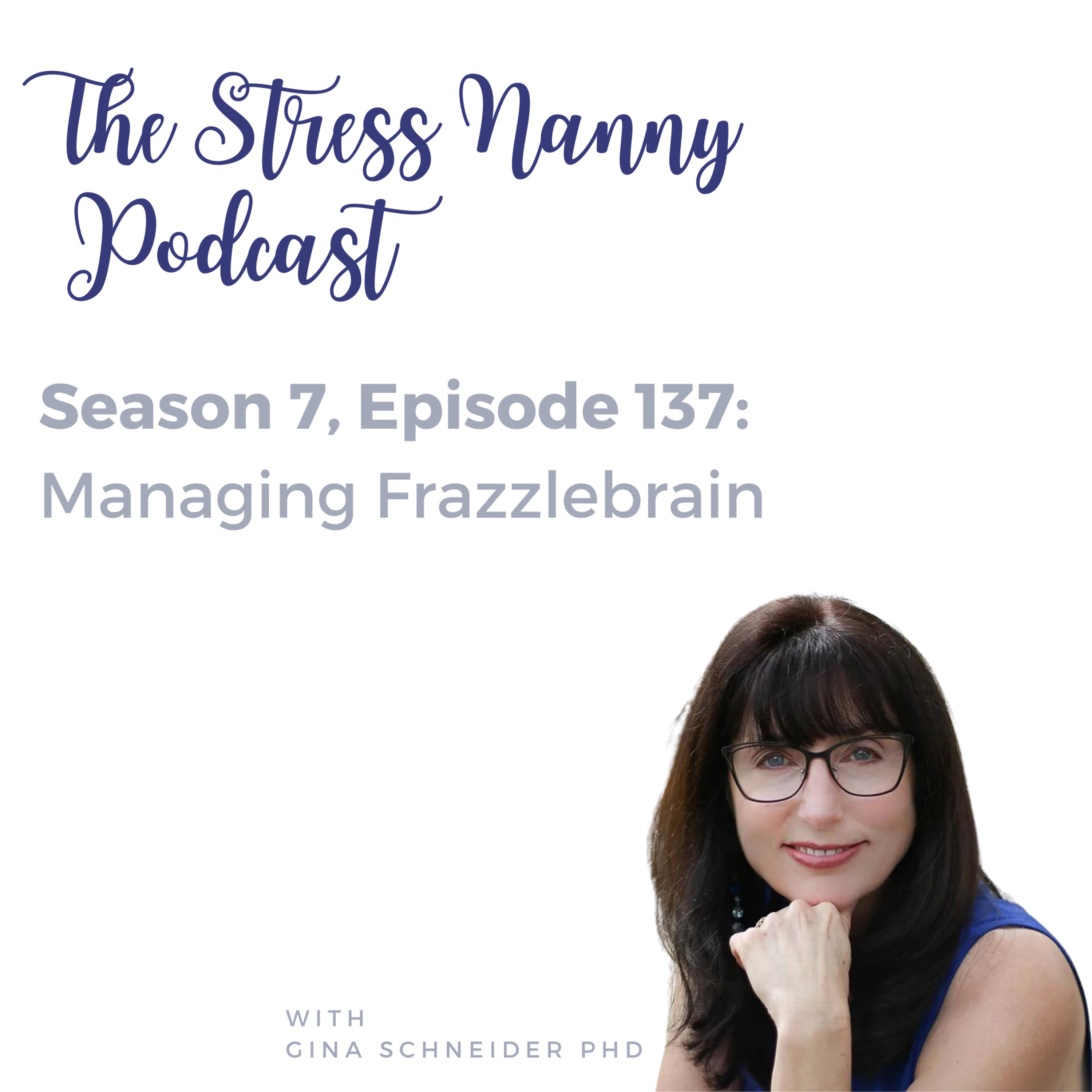
Managing Frazzlebrain


 Apple Podcasts
 iHeartRadio
 Spotify
 Amazon Music
 Castro
 RSS Feed
 TuneIn
 Podchaser
 Goodpods
 Castbox
 In this episode of the #8 ranked stress podcast, Dr. Gina Simmons Schneider shares tips from her book Frazzlebrain. Our conversation will help you see how anxiety, stress and anger combine to create moments of overwhelm and Dr. Schneider will share easy-to-implement strategies for bringing back a sense of calm. With her fantastic phrasing, Dr. Schneider's insights will help kids and grown-ups alike!
Dr. Gina Simmons Schneider is a licensed psychotherapist, award-winning blogger, certified coach, and corporate trainer. She is the author of Frazzlebrain: Break Free from Anxiety, Anger, and Stress Using Advanced Discoveries in Neuropsychology (Central Recovery Press, March 2022). Simmons Schneider serves as co-director of Schneider Counseling and Corporate Solutions, with more than 25 years of experience helping individuals, couples, families, and organizations manage anxiety, anger, stress, and conflicts.
Simmons Schneider writes for Psychology Today, was a regular contributor to Women In Crime, Ink, dubbed by the Wall Street Journal “A blog worth reading,” and Forbes’ blog “Crime, She Writes,” sharing psychology research on crime and media issues. Simmons Schneider guest blogs for other popular sites, including The Feisty Writer, Breaking the Cycles, and Blog Talk Radio programs including Sandra Brown’s Safe Relationship Magazine.
Dr. Simmons Schneider has been quoted in the New York Times, Los Angeles Times, and the San Diego Union-Tribune. She was interviewed for the BBC World Service program, “How to Be Angry,” with Laurence Knight. She contributes to online media podcasts covering a variety of mental health topics.
Lindsay Miller is a kids mindfulness coach, mindfulness educator and host of The Stress Nanny Podcast. She is known for her suitcase tricks and playful laugh. When she's not playing catch with her daughter or rollerblading on local trails with her husband, you can find her using her 20+ years of child development study and mindfulness certification to dream up new ways to get kids excited about deep breathing. Having been featured on numerous podcasts, platforms and publications, Lindsay’s words of wisdom are high impact and leave a lasting impression wherever she goes. To download Lindsay’s Mindfulness At Any Age Guide click 5:92c99b91-42a7-4655-ae85-631f15636dd3" target="_blank">here. To rate the podcast click here.
Lindsay Miller 0:07
You're listening to The Stress Nanny podcast and I'm your host, Lindsay Miller. I'm here to help you keep an eye on your family stress levels. In our fast paced lives, the ability to manage stress has never been more important for kids or adults. When it comes to stress, we have two choices we can decrease stress or increase our resilience to it. Here on the number eight ranked stress podcast, I interview experts and share insights to help you do both. When you tune in each week, you'll bring your stress levels down and your resilience up so that stress doesn't get in the way of you living your best life. I'm so glad you're here.
Hey, there this is Lindsay. Thanks so much for tuning into the podcast. This week. I'm talking to Dr. Gina Schneider. And my encouragement for you is to listen to the fun phrases that she uses. Because whether we're grownups or kids, these phrases are gold, pure gold. I hope you enjoy the episode. Welcome to this dress nanny podcast. I'm your host Lindsay Miller and I'm so glad you're here to take your stress levels down a few notches. I can't wait to introduce you to my guests today, Gina Schneider. She is a PhD co director of Schneider counseling and Corporate Solutions. She's a licensed Marriage and Family Therapist and certified coach with over 25 years of experience providing counseling, coaching, training, and consulting services for organizations, individuals and families in San Diego County. Her book frazzled brain break free from anxiety, anger and stress. Using advanced discoveries in neuro psychology provides evidence based coping strategies to foster calm resilience. Dr. Schneider writes helpful articles for Psychology Today and the award winning M A D blog with Jay Schneider, licensed clinical social worker. They manage the anger daily blog, and that provides information about conflict, anger and stress management, as well as stories on other mental health issues. Dr. Schneider thank you so much for joining me today. I cannot wait for this conversation.
Dr. Gina Simmons Schneider 2:10
Thank you so much. I'm really happy to be here. Thanks for having me.
Lindsay Miller 2:14
It is my pleasure. So as soon as I was introduced to Dr. Snyder's work, I was floored by this phrase frazzle brain so we're gonna start there. There are so many ways to describe stress and anxiety. But because I work with kids, I'm especially attuned to the ways that are going to be a little more playful and fun. And also like you and I chatted about before we started, normalize the process of feeling stress and anxiety. So let's start with frazzled brain. How did you come up with that phrase and explain to our listeners what it is?
Dr. Gina Simmons Schneider 2:47
Well, thank you. That's such a fun thing too, because I do believe that the word frazzle brain can put a smile on our face even when we're feeling frazzled. And one of the reasons I wrote the book is because frazzled is the term for the day, I think so many of us are just frazzled, we're feeling pulled apart in so many different ways. So my original title for frazzle brain was heal your frazzled brain. And in my writing, reading critique group, one of my colleagues said, Well, how are you doing with that frazzle brain book and I went here, read that that's a much better title frazzle brain, it's easy to remember. And really what it is, is a condition where most of us experience emotions, multiple emotions at once. You know, we don't just go, Oh, I'm feeling angry right now we're angry and then we may be a little bit looking forward to something in the future and a little bit frustrated and you know, a lot of different feelings coming at us at once. And the feeling of being frazzled is really a combination of emotions. It can be I'm nervous and worried about something I'm feeling maybe a bit overwhelmed, like my, at the limits of of my resilience. My head feels kind of foggy and clouded. That's sort of the brain part feeling. You know, it's difficult to concentrate when we're feeling overwhelmed with stress and anxiety and anger. And those tend to go together. So in my work in anger management, I found that a lot of times people who present with angry episodes at work or an angry moms, right, and dads, you know, when we present with with anger, a lot of times what's driving it is a fear and anxiety about, you know, oh, what if my child doesn't get this and they have problems in life and so we're rent we're overreacting to our child's misbehavior, or, you know, because of that underlying anxiety. So what happens and I call it the three headed monster As you'll have something that is making you feel worried and anxious, you'll have you'll feel angry about a particular stressor or your child's misbehavior. And then there's an external stress, we've got to get to school on time, you've misbehaved, where's your backpack. So all of these things kind of come together. And it fogs, our concentration, it fogs our focus. So that's what frazzle brain is, it really is this combination of anxiety, anger and stress. And, and it's something we all sort of intuitively recognize. It's like that that's what most people when they hear the title frazzle brain, they go, Oh, I know what that is. I felt that, you know, I felt that. And so it's helpful to go, Okay, this is normal. This is what all human beings experience from time to time is that life is hard. And we feel sometimes overwhelmed. And we don't always know how to cope or how to handle what we're going through. So isn't it wonderful to know that that's okay, that we feel that. And then the next step is, how do we expand our coping skills? How do we get better at managing and recognizing, first that we have frazzled brain and then managing it so that we can feel effective in our lives? And that's learnable. And we can all learn how. And so that's kind of hopeful, I think,
Lindsay Miller 6:38
yeah, for sure. Well, and just with the recognition that so many people right now are experiencing that, right? Like I love the way you described it and put it in such easy to understand terms, like a three headed monster again, that's such good language for kids, right? Like, oh, frog's brain, you're dealing with a three headed monster. Like, which of the heads should we cut off first? You know, defeat work with whatever first. And I think, yeah, it's powerful also to recognize that, in terms of anger, I'm so glad you pointed this out that a lot of times when we're feeling angry, there's underlying anxiety and stress. And it manifests as anger or like, maybe that's the like head of the monster that we, you know, are dealing with the most. But a lot of times, there's an undercurrent of those other things. And if they go unaddressed, like you can look at the anger and you can cut that head off or, you know, figure out how to tame it. Maybe let's tame it, because I don't, I don't think we should have to cut it off. With it. That's kind of brutal. Yeah, if we tame it, and then but we still have the anxiety and the stress, then we're, we're still it's gonna like rears its ugly head again, because it's energized by those other things. And so I'm so glad you pointed that out. And let's, I'm so excited to dive into the strategies. But before we do that, talk to me about how like this understanding of neurology from like a micro perspective, like the individual person's brain, then also globally, we have so many people so many of us have frazzle brain, right. So what does that translate into culturally and kind of how does that impact us, you know, in our individual lives and in our families?
Dr. Gina Simmons Schneider 8:28
That's a wonderful, big question. Because it's true. Like we have global stress, right? We've had the pandemic of COVID. We've got war in Europe, we've got political strife at home. We have families being torn apart by political strife, which is causing a lot of frazzle brain and families. I've worked with a lot of families who are having conflicts around. I can't go to my relative's house because they aren't vaccinated, and I have a health condition. So I can't see my mom. And Mom is angry about that. And now we're having fights because we perceive the risk differently, have different beliefs have different sources of information, even within families. So that shakes our core foundation, because our family is kind of our foundation of our support system. Many people don't have a very strong family support system. So you know, that is a something a coping strategy that I talk about in my book too, is relationships and how to build strong relationships. So we have that those big things that are happening and throughout human history at this is one of the things that calms me a bit is that throughout human history, we have had big crises. You know, we've got weather events. We've got we've had the Germs and flu epidemics and smallpox and all kinds of different illnesses throughout human history that have shaped, shaped our history and, and caused all kinds of suffering that we have had to cope with. So in a way, it is normal to have some some of these things affect us. But it doesn't feel normal, right? Because we have to change our behavior, we have to wear a mask, we have to get a vaccine, we have to do all these different things. So So yes, so those are the macro background stresses that are constantly going on, right, and parents having to make decisions about sending my child to school, not sending my child to school homeschooling, can we do that all of those stresses are were new in the last couple of years under COVID. However, those stresses have existed in our human history, because some parents couldn't send their kids to school because our kids needed to work to support the family. So we've had, you know, human stresses like this. And I think that gives me hope to that. We also have recovered and gone on and had really fulfilling lives, beyond these, these big, big things. But that can stretch the coping skills and stress the coping skills of of any family, and any individual. So then you go down to the individual level where your kid and girl is going to school. Right? And you're nervous about some of the pressures going on. I know a lot of kids are nervous about school shootings. They're nervous about COVID. They're nervous about the normal things that we're nervous about, like, is somebody gonna like me? And why doesn't So and So play with me in the playground? And so those are the normal kinds of everyday anxieties that we have, am I going to be accepted in my peer group? How do I feel about how I'm doing in school and those sorts of things, so, so those are the more micro personal stresses that are still coexisting with all of these other stresses. And so one of the things that I've been working with and with a lot of the parents that I work with is really trying to empathize. There was a study that was published in the monitor on psychology, a couple years back about how parents woefully underestimate the amount of stress their children experience, because parents tend to think I'm carrying all the stress for you, I'm making life easy for you, I'm trying, you're all you have to do is go to school and do your homework. But we really underestimate how much real life stress that they experience. And I think that's a good way to kind of open our hearts to our children and be more effective with our children is opening the window for them to be able to talk about those stresses and not minimizing them. You don't have to maximize them, or exaggerate them. But acknowledge that hey, yeah, that is it is hard being a kid today. Yeah,
Lindsay Miller 13:32
that was such a great summary. Thank you so much for highlighting all of those global and then specific stressors that we're navigating. And I think a lot of families are also navigating residual stress, whether it's like things that they kind of shoved down during the pandemic, just to get through and are now surfacing kind of with a vengeance, or that head of the monster is finally like, Hey, you have got to address this. And then also, I love how you pointed out that the children's stress is often overlooked, or maybe minimized in family settings. And that's not to say, I mean, we're all busy. No one's intentionally trying, you know, trying to make kids feel like they're not validated. However, I think we do sometimes forget that like developmentally, like we have to consider stress through a developmental lens. And if they're this age, and have navigated, you know, this amount of stress, but only have lived this long and cultivated this many skills to deal with it. That that that does feel huge. I mean, there's so many of us as adults who with the pandemic, or you know, felt overwhelmed or still kind of make your way through it. So and we've had, you know, however, I've had 42 years of learning to manage stress, but we have kiddos who have had five years, seven years 12 years of stress management learning, and it just in a lot of instances has not been Enough, right? Like you said humans can adapt in, they're doing an incredible job of evolving to meet the levels of stress that they're facing. However, I think when we look at it developmentally, it can help imbue our perspective with some of that compassion that you talked about, and help us offer empathy, like, oh, my gosh, I'm stressed out in modern living, and I've been trying to figure out how to live in the world for 42 years, you know, and so if you're, you're carrying this, you know, a high level of stress, maybe you're not worried about getting, you know, a roof on our heads and food on our table and making sure our cars are running, but you're still navigating a lot of the social stress and the learning academic stress. And it just is, is a lot. It's a lot for kids. And so thank you for highlighting that and pointing out that, in any instance, empathy for ourselves, and anyone who's around us, you know, navigating stress is the is the answer.
Dr. Gina Simmons Schneider 15:58
Yeah, and I think a lot of times, years ago, I used to work with angry adolescents, I had an anger management program for teens. And I also worked with young kids in hospital settings as well. And one of the things that I noticed is a lot of kids will heroically hold back their worries and fears to take care of their parents, if they see their parents as burdened and stressed out and worried and upset. Children need their parents to be okay, first, because children lean on us, for their well being. So many kids are very heroically holding back stories of bullying, or they're holding back their own feelings of being scared to try to be good little boys and girls and make mommy and daddy feel feel okay. And I think if we just notice that and what and, and, and recognize that maybe our children, if they're being especially good, they still might have something they need to talk about. And if we can put ourselves in a calm place, psychologically, and be reassuring our children, that we're okay that we're managing, and yes, maybe I was irritable, and bit off your head, you know, a barked at you this morning, I'm completely fine. And I can handle whatever you have to share with me, because I love you, you know that those kinds of messages and families can go far, because many, many times I've worked with kids, and they have held back pretty dramatic things. Because they're trying to protect their parents from pain. And so I do think that's something for parents to keep in mind not to worry about in terms of, you know, if your child is doing good, it doesn't necessarily mean that that's a bad thing. That's often a, you know, what we want for our children, we want them to be happy. But if you are seeing your child acting out or overreacting to something, or behaving in a way, that's not typical, behaving especially good when normally they would be, you know, that might be good to take note of, and recognize that maybe there's some underlying anxiety driving that misbehavior, as opposed to just seeing this as my child is just being a royal pain trying to torment me this morning. So I do think when we see this kind of acting out in misbehavior, if we can reframe it in our own mind as the child is experiencing some stress and anxiety, and it's coming out, and I know what catch up or whatever the behavior is, that just seems over the top. That can also be very helpful, because we can just calm ourselves down and enrollment and, and ask, you know, what's going on?
Lindsay Miller 19:14
Yeah, yeah. That's, it's humbling, you know, to hear that, that, you know, kids have a tendency to withhold or hesitate to share in the interest of a parent's well being but, you know, I've seen I've seen that as well, where kids don't feel like they can bring something forward or they've, you know, in my own family, that's happened during times of grief where my grief has been so overwhelming that, you know, my daughter, we ended up in the grief therapy group because I was like, I clearly cannot show up for you in the way that I want to. And so I need to put you in a space where you can share and that I can uplevel my ability to show up for you. And it was so healing because in those moments, so many things did come out that she just hadn't told me when she was little you No she and she was processing the big stuff. And so I can really relate to both sides of that, like a professional perspective on it. And then personally, those moments were like, Okay, this is real, like they will, they will not share in moments when it feels dicey or they don't feel like we have capacity. And I think it's so powerful to learn to sit with them. Last week, I was listening to a podcast with Becky Kennedy. And she was talking about benches and how like, throughout our kids lives, they're gonna sit on a lot of benches. So life is this big park with a whole bunch of benches. And the different feelings they feel are represented by the benches. And our ability to sit with them on any bench that they're on is the key, like, we just have to be able to show up on that bench with them. And I thought it was so powerful, it reminded me of what you were just saying right now, which was just be able to be there with them. You don't have to have all the answers. You don't have to necessarily even fix it, you know, but you just have to be a caring and loving empathetic space for those things to emerge. And that's why I'm so excited about this conversation. Because I think most we want to do that right? As parents as caregivers, like that's where we want to show up for people. But a lot of times that three headed monster is getting in the way, right? And we're feeling anxious, too anxious to sit with something uncomfortable. We're feeling angry or feeling, you know, high level of stress and so we're not able, or we have frazzled brain, right? And we're not able to kind of sit with them in those hard moments. So you have, we're not gonna be able to even touch on, you know, half of them, because this book has so many great strategies, but can you walk us through some of the frazzle hacks so that we can show up in that way? Like when we notice what's going on? Like, Hey, I've frazzled brain right now this three headed monster is taking me over? How do we first of all for ourselves kind of settle that? And then, you know, we can teach it as we as we figure out how to get more proficient at the strategies?
Dr. Gina Simmons Schneider 22:01
Great question. And, you know, it really fundamentally starts with self awareness. It's an inside job first. So I think a lot of times are one of the pressures we feel when we're feeling frazzled brain is we're feeling a sense of urgency to, like, I gotta get this done, I gotta fix this, I've got it. And we're feeling some fatigue and some clouding of our judgment and our ability to concentrate. So what that is, is nervous system arousal, our nervous system is pumping, a lot of stress chemicals, you know, we've got the cortisol, cortisol going through our, our heart rate is elevated, our breathing is more shallow. And then and we are in some kind of mild fight, flight or freeze. If we goes on too long, we can be kind of feel like frozen. Like I can't even get off the couch. I just feel like oh my gosh, overwhelmed. So frazzled brain is sort of a range of condition, you know, condition, intensity. So what do we start with, I always start my frazzle hacks, not everyone, but a lot of them just start with breathing and deep breathing. And everybody hears this, right, everybody hears, breathe, breathe, breathe, and they don't do it. You know, they don't do it. And, and I think I think they don't do it, you know, because they think that's too simple. Everything's too complicated. It has to be more complicated than that. And also, they don't know why breathing, deep breathing, deep diaphragmatic breathing where your diaphragm muscle kind of goes way down. And you can fill up your your lung capacity, and you slow your breathing way down. And they don't know why that is supposed to work. And so they don't do it. And so, but here's what you get when you do deep breathing. And what I teach people is to do deep breathing through your nose. And we do either six by six by six or five by five by five, whether that means you inhale through your nose to the count of five or six, wherever you can start with and then you hold your breath for five or six seconds, count, and then you breathe out through your mouth like you're breathing through a straw for five or six seconds, and even one cycle of that. And we recommend doing it six times or five times whichever number you pick. Sometimes people with little lungs can only do five and then the goal is to have each exhale slow way down. So it's not like a metronome 12345 You know, that you gradually slow the beats down to where you are really literally slowing your heart rate down, you are stopping the production of the stress chemicals that are going through your brain that are making you panic. You are bringing oxygen to your brain and your prefrontal cortex, which is the reasoning part of your brain. So you will think more smartly. That's what we want to do when we're trying to problem solve complicated things, we want to be able to think in a smarter, clearer way. So the breathing really is starting with slowing my nervous system arousal down, we're aren't going to make good decisions just operating out of frazzle brain I was at I was in the market the other day. And, you know, I'm standing in the vegetables, looking at which vegetables I'm going to pick, and this woman comes around the corner and I'm in a cart, and she's just like, why are you in front of me, you know, and she's just furious at me for just being there. And, you know, my heart went out to her. And I'm like, proud of the brain. You know, the, the inability to recognize that when you go to the supermarket, there will be other people there and you might have to move around them adjust. You might, and they, you know, this poor woman is is operating on a at the end of her her bandwidth. And if there were any other serious things going on in her life, she's probably not going to manage it very well, right. So we've all run into that. And maybe we've all been in that situation too at times where we felt so pressured, that we can't even have patience for somebody standing in front of us. So that is also something to take note of is if you are overreacting to something that you normally would overlook torque toys in the living room floor or whatever. Normally that's a that's a normal part of my day, I got toys in the living room. And this day you come in and it's just infuriating. Boi hasn't everyone cleaned up, you know, for me, then then you, you can take a note and go wait a minute, I need to lower my nervous system arousal because I don't need to have the toys on the floor, just destabilize me emotionally stabilize me emotionally. So it starts with self awareness. If we don't have that self awareness, we're just acting out like that woman in the grocery store. She clearly didn't have awareness that she was at the max of what she her coping skills. So we have that's why it starts with breathing too, because as soon as we start breathing, we are acknowledging, I am over hyped up right now. my nervous system is, you know, elevated. So then the next thing is to really look at how are we thinking? And I have found that when people ask themselves, why am I so upset? They get more upset. Because if you're asking yourself, Why am I so upset, then what is your mind going to in the filing cabinet? It's opening up the drawer of I'm upset. And it's looking through all the things in our life to be upset about, you know, my husband doesn't help in the kitchen. My kids don't pick up their toys. The teacher was rude to me. That's right. That's why I'm upset. So what does that do? That just makes you more upset? Because now you're looking at this massive filing cabinet full of upset things. So why questions are not helpful. And it's counterintuitive, right? It's like if your car's making noise, making a weird noise. The glide question might be useful, like why is my car making weird noise? Maybe I need to take it to the shop and get it fixed. But asking ourselves, why am I why am I so amped up right now? Why am I so hyper aroused? isn't actually a helpful question. It's more what am I feeling so that the what questions are helpful, you know, what am I feeling? So then you find a word for it. Maybe you call it frazzle brain, maybe you call it My feelings are hurt. Maybe you call it I'm feeling stress, or whatever the feeling is, but you flip you name the feeling. And people hear it read this all the time, stress management, name your feelings, and they don't do it. Because it sounds too darn simple and easy. And it can't be easy. Because the complicated problems are so complex. That solution must be so so complex and it's just it's not true. So when we name the feeling, so we say you know what am I feeling I'm feeling stressed. What do I need? Another? What question? What do I need right now? So the key is right now. Right? Because a grownups, we might, if we say, what do I need? That question could be massive, you know, I need a retirement plan I need like, I need a new water cooler or water heater in my house, I need help. I need whatever. So the but what do I need right now in this moment, when I'm feeling it, this is where it's happening. This is where the reality of my feelings are happening. They're happening right now. What do I need right now? You know, sometimes I give an example. It's a silly simple example of coming home from work one day. And I'm noticing that I'm feeling really irritated because I realized I have to pick up something at the market that I don't have for dinner, and I'm hungry, and I'm tired. And I'm gripping the steering wheel. And I'm noticing that my tent, there's tension in my neck and shoulders. And then I'm getting more irritated, you know, so but in noticing all of those things, then I'm gradually loosening. Oh, that's why my hands are sore have been gripping the steering wheel for the last 15 minutes, you know? And then I asked myself, What am I feeling? I'm feeling hungry, tired, and irritated that I have to go to the market to get this thing that we need for dinner. What do I need right now? I need a snack to give me some fuel. What can I do to make that happen? Well, I'm going to go in the grocery store and get a snack. Or I'll get something to raise my blood sugar, you know, so I'm not so I feel like I have a little fuel. Maybe a little treat to that makes me feel a little better. So I have energy to make dinner.
And all of a sudden, I'm coping better. I'm going to be okay, I can cope better I can give myself that little blood sugar increase and, you know, go through the market, grab the thing, get home, make the dinner and now I have enough energy. Now, are there times that I might have just completely ignored that? And then that lady in the supermarket that will look for really irritated everybody in her way? Yes, I could very well be that person on any given day. So but the what what am I feeling right now? What do I need right now? And what can I do to make myself feel better right now? And so that's what some of the frazzle hacks are, we start with the breathing and, and then what our brain is doing, what are our focus thoughts doing? Are they taking us into the Why am I upset drawer and we're going through all the things that make us upset? Not helpful. We're asking ourselves, what can I do now, that's also that's very helpful. Because in the moment, we can do a lot we can breathe, even if we're stuck in a meeting at work. And we're feeling flooded with, oh my gosh, there's going to be a merger and I don't know if I'm gonna have a job and there's going to be a new boss. And, you know, we can do the breathing technique, we can do that. What do I need right now? What can I do when I get out of this meeting? Can I call somebody? Can I get some help. So as soon as we start with our inside nervous system arousal, and start to lower that arousal, and then give ourselves that plan from those what questions now we have a plan, and we just work our plan, and we're going to be more effective if we have a plan that includes our nervous system, and how it operates. So that our brain gets the oxygen it needs, and so on.
Lindsay Miller 34:02
Yeah, it seems like you said, so simple. I love the way that you laid that out. And I, I've seen the same thing where it's like the complexity of the problem seemed to dictate that the solution should be equally or even more complex, but I love the way you describe that, like, just doing the breathing and then recognizing that why may not be helpful, but what is and I think that's, that's really powerful. It reminds me of Brene Brown talks about how if, if we're in that place where we're so overwhelmed that it's like our feeling emotion, if it's on a one to 10 scale, we're feeling emotion at a 10 we're able to like articulate it at about four and then we're able to manage it at about a two. Yeah. But what you just described is the process for like lowering the intensity of the emotion so lowering the ante density of what we're feeling and raising our ability to articulate and manage so that we can kind of meet. And I love that idea of looking at okay, not like we're not processing it necessarily like what we can do differently next time. That's not the time. What do we need right now? What do I need to bring my, my stress levels down and my ability to cope up? What is what is going to be the thing that helps them meet in the middle? And, yeah, it's such a powerful way to think about it. Instead of feeling the overwhelm that comes with needing to like solve the problem.
Dr. Gina Simmons Schneider 35:38
Exactly. And I think that overwhelmed feeling comes from feeling like we have to solve everything right now. Yeah, we're gonna be okay. Yeah, that is this, this this sort of false narrative that's going on in our mind, when we feel overwhelmed that the only way I can feel better is if I've solved all these huge problems all at once, right. And that isn't actually how problems get solved. They get solved one little thing at a time you make the phone call to the water heater company and make an appointment. And that's one task. You know, that's very manageable, if you bring it all down to that. But if you're thinking everything has to be done, and I've got to Marie Kondo all my drawers and I've got to have at you know, that that is, is the, the mental hook. Nancy, David calls it a hook, you get hooked by this tape that says, I've got to do all these complicated things to fix everything. And I can't do them.
Lindsay Miller 36:44
No, because it's hardly like breathe. It's too
Dr. Gina Simmons Schneider 36:47
much. I can't even think my way out of a paper bag right now. And, and that, what does that do that just fuels the feeling of being overwhelmed. And really, nothing changes in our lives, except this one little thing at a time. And it's in there also is this belief that when we're looking outside of ourselves, like this thing outside of me has to get fixed for the inside of me to be okay. You know, my water heater has to get fixed before the inside. Well, people have lived with cold showers, you know, you're not going to die. Right? But, but we get stuck on this idea, right, that certain things are just unacceptable, I can't handle it. And it has to be fixed before I can be okay. And I challenge people over and over again that that is completely bunk and not true. That people can be okay in a in a war zone. People can manage enormous stress during times of grief because again, we have multiple feelings that can come at us. And happiness bubbles come up. You know, you talk about grief. You go to funerals, there's crying, there's laughter. They're sharing wonderful memories. There's love, there's hugs, there's affection. There's absurdity. I've been at funerals, where just you had a laugh at some absurd thing that happened. And you're like, wow. And yet at the same time, you're crying and grieving the loss of a loved one, right? So. So this is how life comes at us. So we don't need to have it all figured out at once. And in fact, we can't. So just throw that idea out of your brain. And instead, bring it back to the present moment is where things happen. And the present moment, I can be okay inside. Even if my company has a merger, and I might not have a job next week. And, you know, whatever. You don't have to figure out the whole rest of your economic future or your child's well being I remember when my boys were a few years from going to college, and I had this moment of panic where I was like, Oh my God, I've got to teach them everything they need to know for Independent Living, like in the next two years, because they're going away to college, you know? So I'm like, and then I and then I had to just walk myself through the steps. And it's like, well, what can I do now? What what do they need? Well, they can start doing their own laundry. Yes, of course. And let's do a cooking night where they get to cook and I'll teach you know, and they will make family dinner one night a week. Okay, so I started breaking it down into little things that what I was worried about them not being competent at yet. And we're fine, they're fine. You know, they're even better than than me at dinner parties and all that stuff. So but You know, as a parent, you panic at times about the whole rest of your child's life. And it's helpful. It's a helpful mental exercise to just bring yourself back to, well, what what could I do right now to formulate into a simple little goal that could help my child move from this skill to, to this skill level? Yeah. And that's really a lot more manageable. Right, it's a lot more easy to get our mind around and thinking about the whole rest of their life.
Lindsay Miller 40:35
Yeah, definitely will. And again, like tuning into the logical part of our brain also, right, like getting us out of that. Completely emotive, like just feeling everything part and tethering to just some logical step forward, also helps to settle in so I love Yeah, I love that, like, what do I need right now. And in thinking about it in terms of kids, like as adults, or caregivers, grownups, we, you know, again, I have 42 years verse worth of like, ideas on things that helped me feel better, right things that help right now. And one of the things that I advocate for with kids is helping them make a list during times when they're calm, of things that are helpful when they're overwhelmed when they're anxious, when they're stressed when they're angry, like what what do we know helps, and how can you access that thing? When you're upset? What what is one of your favorite ways, like to help kids meet that need of like, what do you need right now? What's something you've seen work really well for kids?
Dr. Gina Simmons Schneider 41:34
Well, there's quite a few things. And a lot of it depends on what the particular behavior is. But I'll give you an example with my son. I remember one day picking up my son from elementary school. And he's like, this has been the worst day everything's gone wrong. It's the worst, everything, it's, it's terrible. I hate it. You know, and I and so and I said, you know, we'll, we'll what happened, you know, and, and he's like, you know, well, I left by homework at home and my teacher, you know, got mad at me. And, and, and, you know, it's just everything is terrible. Everything is Terrible, right? And so he was also globalizing it too. And my whole life is terrible. And he was overwhelmed. And so and looking at everything from a very pessimistic, negative lens, you know, everything is saying, you know, so like, I said, Well, I, let's just talk about that word, everything. Because I remember, you know, we had a really good breakfast this morning as you like, your breakfast and and he said, Yeah, I did. I did. Because I remember you saying, you know, it was really good. And you know, yeah, I did. I did like my breakfast, and we got to school. Okay. And then got to see your friends. And did you? Did you play on the playground? Well, yeah. Well, did you have some fun? Well, yeah. So what actually did go wrong? Okay, well, I left my homework at home, and my teacher got mad at me. Okay, so you had, you know, two events happen, that were upsetting today. And the rest of the day was pretty good. So far, and there is not over yet to and we're gonna go home, and we're gonna have a nice dinner together. And you can play after you do your homework. And so you're probably going to have a pretty good rest of your day, too. And so, so the, what I taught him over and over again, because he was one of these deep thinking, very sensitive, highly sensitive personalities a little that, you know, would immediately go to a pessimistic explanation. And so one of the things I tried to bring him down to was using not using words like everything in all ways, and getting back down to the specifics of and talking specifically about what is upsetting you, as opposed to making it a bigger thing than it actually is, or exaggerating it or blowing it up, like a big giant blown. One rarely is just this little piece of rubber, you know, it's not this big giant thing taking over your whole life. And, and so a lot of times, kids, when they're feeling overwhelmed and adults, we all do this, we will exaggerate the importance of something. And so, a lot of times, I'll I'll ask kids to be really specific to describe what's upsetting them. And sometimes it gets down when they say it out loud. The specific thing that bothered me was that this girl at school was caught, you know, telling this other girl that I made fun of her, and it made me feel bad. I know. And so now you're dealing with a specific thing that's very manageable. So how do we handle this social conflict? At school, and no, that doesn't mean that nobody likes you. You know? So I think sometimes we feel overwhelmed when we exaggerate. So a lot of times I tell kids to just, let's describe it in a really specific way. Yeah,
Lindsay Miller 45:17
that's really powerful. I love the example you shared with your son. And then the example you shared just now, because I think it brings us back full circle to kind of where we started in empathy. And how the what in a lot of those instances the like the immediate what is that they need empathy, like, what will make this situation better is to be seen and heard and trusted, like, yes, you that felt awful? Yes, you were super frustrated? Yes, you felt really angry or embarrassed when you forgot your homework, like not saying don't worry about it, or it's not that big of a deal, right. But offering that immediate empathy. And then, like you said, being able to help walk them to the next step, whether it's helping them recognize that it wasn't actually their entire day, that was awful, but a few small pieces, or, you know, redirecting attention, or intervening or advocating in whatever ways that resonant but that that's really beautiful, that the what a lot of times for kids is just that empathy. Like, you can't show up and ask those questions if you don't believe them to begin with. Right.
Dr. Gina Simmons Schneider 46:21
Right, right. And I do think you're right, I mean, for parents to have empathy with developmentally what their kids can understand at a particular age, but being with them where they are, and giving them the words to describe it to sometimes that is, what a lot of parenting is, is one of the examples in my, in my book is when my daughter was a toddler, she was about two and she skinned her knee and was the first time she got a bloody knee. And she looked at me horrified, just sheer terror in her face, and said, is all my blood gonna fall out? And of course, it never occurred to me that, you know, be think that but I was just like, oh, no, honey, you know, there, this is normal. And, you know, this just means you've been having fun playing, and you got a skin knee, and that's really normal and your knees gonna heal and you're gonna be okay. And the body heals itself and all of that. So meeting your child where they are, it's like, wow, that would be a horrifying feeling. And a lot of kids when they're in bathtubs, too, when they're really little, and the water starts disappearing down the drain, am I gonna go down the drain, you know, because they where they are, is they're scared, they don't know, Oh, I haven't sat in the bathtub and watch the water disappear around me. They have to be it, you know, you have to explain how you're gonna, you're gonna be still be sitting here in the bathtub. You know? You're okay, you're okay, everything's fine. And so we give kids language for it too. And way of thinking about their struggle. One of the things that Carol Dweck talks about with her, you know, mindset, everybody's talking about mindset, it is helpful to give kids a growth mindset, while you're just learning, you know, and you can learn and you'll get better at this. And, or, in the example with my daughter, I wanted her to make the association that running around and getting hurt just means you're having fun, and you're gonna have get bruises and you're gonna get bumps and you're gonna get skin knees, and you want to have fun, right? So you don't want to be held back from running and playing and skipping and jumping and doing all the fun things that you want to do in your life. Because you're afraid, you know of a few bumps and bruises so you set the your child's mindset with the language that you're using to describe what's happening to them. And and I think parents can really do a lot in by just how they're, how they're using it. Are they using it in a growth mindset, thinking about the fact that maybe the child can get better at this, and that's okay, and it's normal to fail or it's normal to fall. And you're doing a good job if you're falling and failing because that means you're learning and you're playing and you're having fun and you're living your life.
Lindsay Miller 49:30
Yeah, I love that. I love that so much because I I think the framing is crucial for how kids view themselves and their struggles and then how they navigate stress moving forward and you and I we could go on about this intro for hours. But I just love I love that that's how we ended because I do think as part of navigating the frazzle hacks that reframing and looking at things in a growth mindset is a huge, huge One. So let's let people know where can they find your book? How can they learn more about your work?
Dr. Gina Simmons Schneider 50:06
Oh, thank you. Well, I do have a website frazzle brain.com, if you want to check in with me, and you can subscribe and get updates on on what's going on the book is available wherever books are sold. Amazon, you know, Barnes and Noble, bookstore, bookshop. If you'd like to support indie books, you can order it pretty much anywhere that you would buy books. It's in a paperback. So it's pretty affordable. And it has a lot of things that can deal with a lot of what people have, the feedback people have given me and I worked really hard to do this is to make a book that is soothing to read. Because a lot of the anxiety books that I've referred to my clients, make people feel anxious and they recreating all these symptoms and and so a lot of people have said that just reading it makes them feel calmer and better and it soothes them. So that was the point of writing the book to to create all these self soothing strategies because we are living in a stressful world. So, yes, but frazzle brain.com, you can also follow me on social media, if you just go to the website, you'll find my social media links, and I follow back, I would love any feedback people want to give me, you can send me an email through their, through the website. And I'll get back to everybody. And, gosh, it's been a pleasure meeting you and talking to you and I love your podcast, you do such a great service to people and I've recommended it to a lot of my clients. So anyway, I'm really honored to have been on your show.
Lindsay Miller 51:57
Well, I appreciate that. Thank you. And I feel like our conversation today has been so insightful for me, and I'm sure it's gonna find its way into the three headed monster. It's gonna find its way into conversations all over the world. Thank you again, Dr. Schneider. I appreciate it.
Dr. Gina Simmons Schneider 52:15
Thank you so much.
Lindsay Miller 52:17
Okay, what did you think okay, frazzle brain and the three headed monster, I just love it, I'm gonna be using those forever. One of the things that I really appreciated was just how she normalized so much. And then also really focused on what is needed in a given situation instead of how we got there. And while I think there are things we can learn from, you know, kind of the analysis of what's going on and how we're feeling. She points out that during crisis is not the time to do that learning. And I just really love that like helping ourselves and our kiddos tune in to what would be supportive, what would be helpful in this moment, and then doing that thing. So here's to us taking good care of ourselves and our kids as we navigate moments of frazzled brain. Thanks again for being here.
You've just finished an episode of The Stress Nanny podcast. So hopefully you feel a little more empowered when it comes to dealing with stress. Feel free to take a deep breath and let it out slowly, as you go back to your day. I'm so glad you're here. If you're a longtime listener, thank you so much for your support. It really means the world to me. If you're new, I'd love to have you follow the podcast and join me each week. And no matter how long you've been listening, please share this episode with someone who is stressed out. If you enjoyed the show, would you please do me a favor and go to ratethispodcast.com/thestressnanny and labor review. The link is in the show notes. I'm so grateful for all my listeners. Thank you again for being here. Until next time!
Transcribed by https://otter.ai